
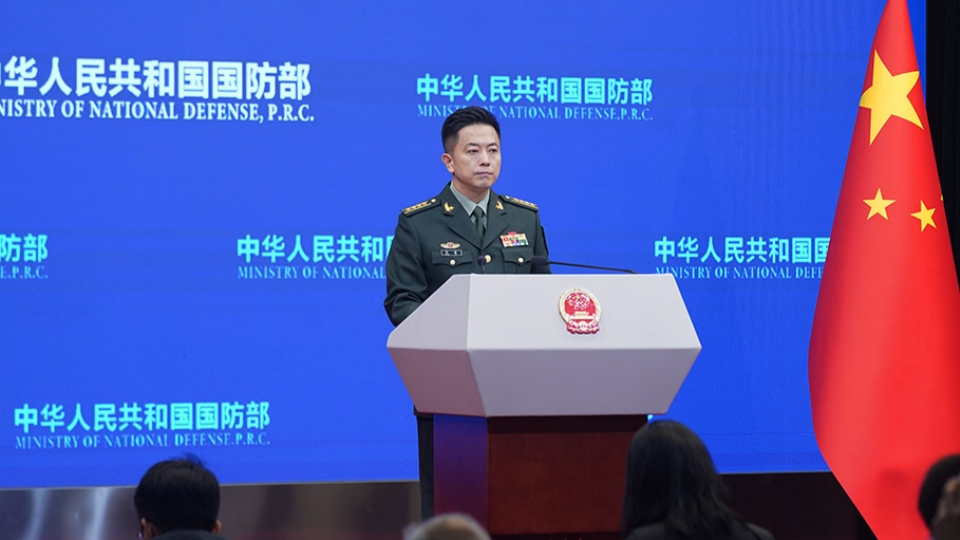
BEIJING, Nov. 26 -- "We require the Japanese side to stop fueling tensions over the South China Sea issue. Any attempt to challenge China's sovereign rights and interests and undermine regional peace and stability will not succeed," said Senior Colonel Chen Xi, spokesperson for China's Ministry of National Defense (MND), at a regular press conference on Thursday.
According to reports, the National Institute for Defense Studies under Japan's Ministry of Defense recently released the so-called China Security Report 2027. The report explicitly recommends Japan to sustain its presence in the South China Sea, strengthen minilateral cooperation with its allies and partners, and oppose China's unilateral change to the status quo by force or coercion. Japan's Ambassador to the Philippines recently stated that Japan will provide the Philippines with coastal surveillance radars and surveillance UAVs through the Official Security Assistance program.
In response to the reports, the spokesperson pointed out that under the disguise of academic research, Japan, in this report, whitewashes its moves to meddle in the South China Sea issue and stoke tensions across the Asia-Pacific, and smears China's legitimate law-enforcement operations. This is yet another testament to the Japanese authorities' ambition to build up its armed forces and break free from the "exclusively defense-oriented" principle. The international community should stay highly vigilant against this.
He also stressed that Nanhai Zhudao is China's inherent territory. Japan is not a party to the South China Sea issue, and is therefore in no position to make irresponsible remarks on it. During WWII, Japan committed numerous crimes in China, including the illegal occupation of China's islands and reefs in the South China Sea, which inflicted untold sufferings on China and the Chinese people.
"In recent years, using so-called external threats as an excuse, the Japanese side has incited security anxiety among neighboring countries, supplied weapons and equipment to regional states including the Philippines, formed exclusive military cliques, and sought to enhance its military presence in the South China Sea by provoking confrontation," said the spokesperson, adding that, "Such moves have harmed the shared interests of regional countries and disrupted peace and tranquility in the Asia-Pacific."
