
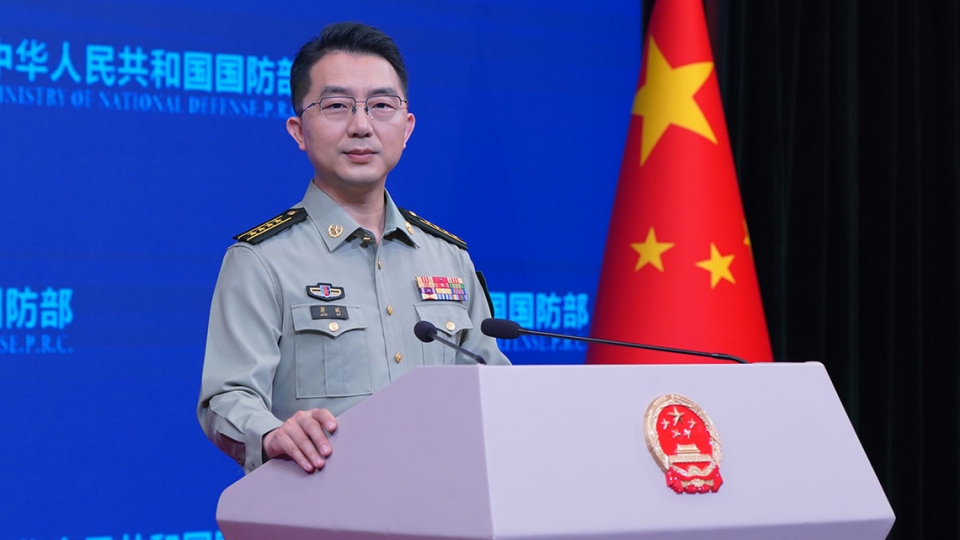
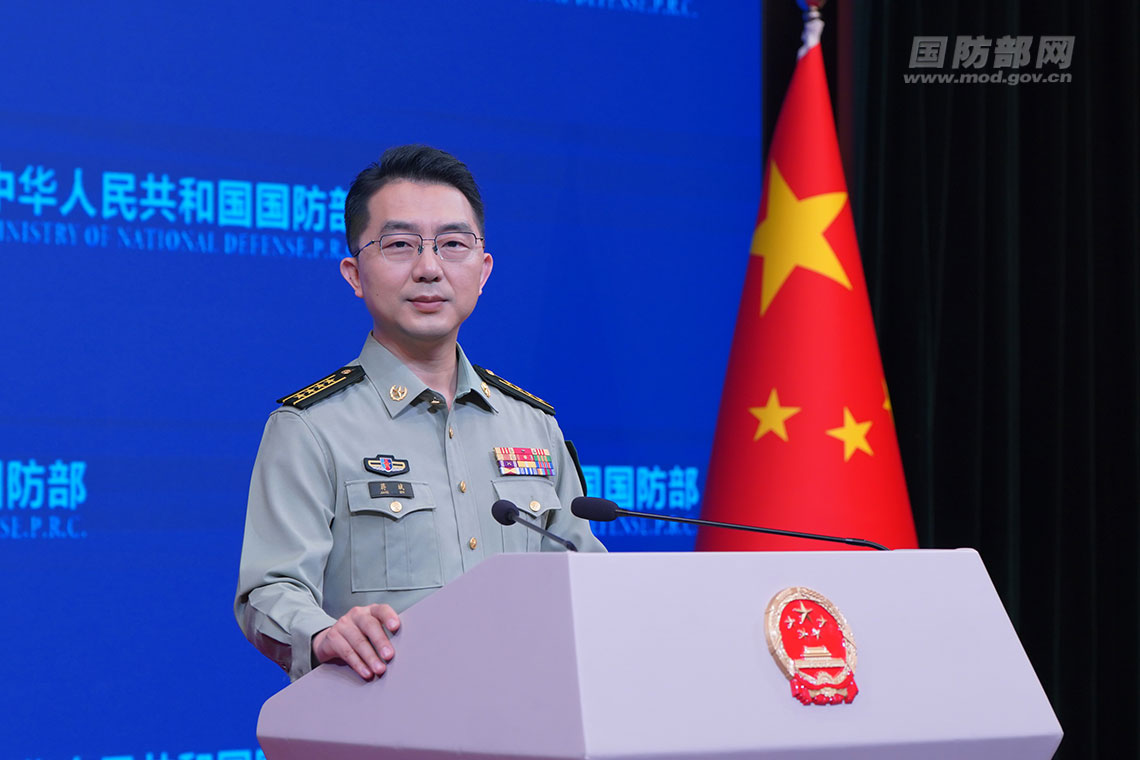
Senior Colonel Jiang Bin, spokesperson for the Ministry of National Defense (MND), answered questions at a regular press conference on the afternoon of September 24, 2026.
(The following English text is for reference. In case of any divergence of interpretation, the Chinese text shall prevail.)
Jiang Bin: Good afternoon. Welcome to the regular press conference of the Ministry of National Defense (MND). I have no information to announce at the top. The floor is now open for questions.
Journalist: At the 13th Beijing Xiangshan Forum, many delegates mentioned that only China and the Beijing Xiangshan Forum can bring together representatives from conflicting parties to share their respective views. What is your comment?
Jiang Bin: After 20 years of development, the Beijing Xiangshan Forum has become a premium international platform for security and defense dialogue. This year, the forum once again convened guests from different countries and delivered remarkable outcomes. First, it promoted equal dialogues with an open and inclusive spirit. There is no precondition for participation and no exclusive geopolitical membership. All countries, regardless of their size and strength, can have the microphone to voice their security concerns and articulate their security visions. The forum is widely commended by delegates as "a table where every party can find a seat". Second, it pooled global consensus with China's visions. The vision of building a community with a shared future for humanity and the four major global initiatives advocated by China transcend the outdated mindset of bloc confrontation and zero-sum games, and offer a new paradigm and pathway for reducing security deficit and improving security governance worldwide. Third, it addressed international concerns with well-targeted subjects. Keeping pace with the evolving global security landscape, the forum's agenda covered both traditional security challenges and those in emerging areas including the military application of artificial intelligence and outer space security governance. It contributed in concrete ways to resolving today's problems and defusing tomorrow's risks for the sake of common security of humanity. Fourth, it advanced peace and stability by seeking common ground while respecting differences. The forum advocates respecting the security interests and different positions of all countries. What makes it different is that it can bring together representatives from conflicting parties and let them have candid conversations. Here, reason and restraint rise above tension and hostility. Every single dialogue adds one more ounce of hope to peace.
The 20th anniversary is a milestone and a new starting point. Following the spirit of equality, openness, inclusiveness and mutual learning, we will make the forum a greater success, and join hands with all parties to make greater contributions to world peace and the well-being of humanity.
Journalist: I have two questions. Firstly, it's reported that the New Zealand frigate HMNZS Te Mana and maritime sustainment vessel HMNZS Aotearoa recently sailed through the Taiwan Strait. What is your comment?
Secondly, it's reported that the Japanese government plans to establish a new defense-related independent administrative agency in FY2027. The body will coordinate defense equipment exports, support emerging enterprises, bolster production bases, and manage nationalized military factories, and also intends to adopt a U.S.-style model to purchase equipment from private firms for re-export. The plan has drawn criticism from Japan's opposition parties, who argue it evokes memories of pre-WWII "arsenals". What is your comment?
Jiang Bin: On your first question, the Chinese military deployed naval and air troops in accordance with laws and regulations to monitor and track the New Zealand vessels throughout their passage, ensuring an effective response. We urge the New Zealand side to earnestly abide by the one-China principle and refrain from sending wrong signals to separatist forces for "Taiwan independence".
On your second question, as explicitly stipulated in legally binding international instruments including the Cairo Declaration, the Potsdam Proclamation and the Japanese Instrument of Surrender, Japan shall be "completely disarmed" and not maintain industries that "would enable her to re-arm for war." This is an important part of the post-war international order and serves as a crucial bulwark for the international community against the resurgence of Japanese militarism. In recent years, the Japanese side has dramatically increased its military budget, vigorously developed offensive capabilities, and even massively expanded its military industry in the name of economic development. Such developments bear striking similarities to the warning signs leading up to Japan's aggression during WWII. The international community should stay highly vigilant and take firm actions to prevent Japan's neo-militarism from wreaking havoc.
Journalist: The U.S. Secretary of the Air Force recently confirmed that the U.S. has deployed "on-orbit space control weapons". This is the first time that Washington has acknowledged that it possesses an offensive capability in space. Observers believe this may fuel a global arms race in outer space. What is your comment on this?
Jiang Bin: China upholds the peaceful use of space, plays a constructive role in safeguarding space security, and promotes the building of a community with a shared future for humanity in space. In contrast, the U.S. side is seeking to weaponize space and turn it into a battlefield. This will only intensify arms race in space, turn space into a new arena for major-power rivalry, and ultimately destroy humanity's common home.
Journalist: It's reported that a themed exhibition commemorating the 90th anniversary of the victory of the Long March by the Chinese Workers' and Peasants' Red Army has opened at the Military Museum of the Chinese People's Revolution. Please give us more details.
Jiang Bin: "The Great Expedition: A Themed Exhibition Commemorating the 90th Anniversary of the Victory of the Long March by the Chinese Workers' and Peasants' Red Army" has officially opened at the Military Museum of the Chinese People's Revolution. Embodying President Xi's important statements on the great Long March spirit, the exhibition centers on the theme of "carrying forward the great Long March spirit and progressing along the Long March of the new era". Following chronological sequence, highlighting key events, and focusing on revolutionary spirit and historical takeaways, it comprehensively presents the glorious journey, valuable experience, great significance and far-reaching influence of the Long March undertaken by the Red Army under the Party's leadership. The exhibition also showcases major achievements made in the cause of the Party and the country on the great journey of advancing socialism with Chinese characteristics, as well as tremendous changes that have taken place in former Long March sites over the past 90 years.
The themed exhibition displays 1,061 pieces/sets of cultural relics and documents, of which more than 300 pieces are on public display for the first time, accounting for 28 percent of the total exhibits. By making full use of photos, music and artworks, alongside new technologies such as 3D real-scene reconstruction, the exhibition features a Long March route sand table and brings to life historical events such as the Battle of Xiangjiang River, the Zunyi Conference, the climbing of snow-capped mountains and the traversing of vast grasslands. For the first time, English captions have been incorporated throughout the exhibition. There are also interactive exhibits, such as "I Want to Join the Red Army", as well as document‑search links and QR codes to access songs, providing a more immersive experience rooted in history.
"The Great Expedition: A Themed Exhibition Commemorating the 90th Anniversary of the Victory of the Long March by the Chinese Workers' and Peasants' Red Army" will be one of the museum's permanent exhibitions. You are welcome to enjoy an immersive experience of history to look back on the extraordinary journey, resonate with the original aspiration of revolutionaries, and draw strength, vigor, courage and determination from their stories.
Journalist: I have two questions. Firstly, recently, when the China Coast Guard (CCG) vessel CCGS Sanzhou'ao was on legitimate law-enforcement operations near Xianbin Jiao of China's Nansha Qundao, a Philippine vessel, Magat Salamat (MMOV 3015), ignored repeated warnings from the Chinese side, deliberately altered course and suddenly speeded up to cut across the bow of the CCG vessel, leading to a collision. What is your comment? My second question is that according to reports, Taiwan's coast guard authorities plan to donate the decommissioned vessel Lienchiang to the Philippines. The ship has been registered as a Philippine law-enforcement vessel and is undergoing sea trials in Kaohsiung Port, with delivery expected after refurbishment. The crew of Philippine government vessels once shot and killed fishermen of Taiwan, and have seized fishing boats of Taiwan multiple times in recent years. People on the island have bombarded the DPP authorities for rubbing salt into the wounds of fishermen. What is your comment?
Jiang Bin: On your first question, the CCG has released a statement on the incident. The context is clear and evident, leaving no room for the Philippine side's misinformation. The Philippine government vessel was on a provocative mission in waters near Xianbin Jiao of China's Nansha Qundao, and made a dangerous maneuver like a lane-change cut-off to deliberately ram the Chinese vessel. Such action seriously threatened the safety of the Chinese crew and vessel, and violated international law and the basic norms governing international relations. Playing victim and peddling false narratives cannot change the provocative and illegal nature of the Philippine side's behaviors. The Chinese side will continue to take effective measures to resolutely safeguard our territorial sovereignty and maritime rights and interests, and uphold peace and stability in the South China Sea.
On your second question, in order to advance their separatist agenda for "Taiwan independence", the DPP authorities disregarded the tragedy in which the Philippine Coast Guard once killed a fisherman of Taiwan, colluded with the Philippines, and attempted to use vessel donations as tools to expand so-called official ties. Such acts trample on national dignity and betray national interests, and are condemned by compatriots on both sides of the Taiwan Strait. We urge the Philippine side to abide by the one-China principle, refrain from engaging in any form of official exchanges or military interactions with China's Taiwan region, and stop sending wrong signals to the "Taiwan independence" separatist forces.
Journalist: It is reported that on September 16, local time, the hospital ship PLANS Ark Auspicious, on Mission Harmony 2026, treated a local pregnant woman with pregnancy-induced hypertension and an abnormal fetal presentation in Mauritania. After an emergency cesarean section was performed, the first "Auspicious Baby" for this year's mission was safely . Could you provide more details?
Jiang Bin: Recently, the hospital ship PLANS Ark Auspicious, on Mission Harmony 2026, visited Mauritania and provided medical services to local people. During the visit, it treated more than 7,500 patients, performed over 30 surgeries, provided health check-ups to more than 140 people, and sent medical teams to local hospitals, schools, and communities to conduct health education, medical exchanges and other activities. The "Auspicious Baby" you mentioned is named Mohamed Khalil Sy by his family, which means "the deepest friendship". The name the family's gratitude to the Chinese medical personnel, and is also a vivid reflection of the friendship between the Chinese and Mauritanian peoples.
PLANS Ark Auspicious is on its first overseas mission to carry friendship across thousands of miles and safeguard people's health and well-being. The Chinese military will continue to provide effective and efficient medical services to the people of Africa, deepen traditional friendship and practical cooperation between China and Africa, and contribute to the building of a community with a shared future for humanity.
Journalist: I have two questions. Firstly, Chinese President Xi Jinping is paying a state visit to the U.S. Under the strategic guidance of the two leaders, efforts are being made to build a constructive China-U.S. relationship of strategic stability. We have seen some interactions between the Chinese and U.S. militaries recently. Following the meeting between theater commanders at the end of last month, the U.S. raised the level of its representative to the Beijing Xiangshan Forum. How does China assess the current military-to-military exchanges between China and the U.S.? Will the two sides resume dialogue between military and defense leaders in the coming period? Secondly, as Chinese President Xi Jinping is on a state visit to the U.S., it is widely anticipated that U.S. arms sales to Taiwan will be one of the key topics on the agenda. What is your comment?
Jiang Bin: On your first question, head-of-state diplomacy plays an irreplaceable strategic guiding role in China-U.S. state-to-state and military-to-military ties. We are willing to work with the U.S. side to deliver on the important consensus reached by the two presidents on military affairs, strengthen communication and dialogue, carry out practical cooperation, properly manage differences, and keep the military-to-military relationship stable, sound and sustainable, so as to play a positive role in building a constructive China-U.S. relationship of strategic stability.
On your second question, for updates on President Xi's visit to the U.S., I'd refer you to official news releases. I want to underline that the Taiwan question is the most important matter in China-U.S. relations, and preserving peace and stability across the Taiwan Strait represents the greatest common ground between China and the U.S.. We hope the U.S. side will handle the Taiwan question with utmost prudence.
Journalist: It's reported that the Philippines recently rallied some countries to conduct a field training exercise under the ADMM-PLUS Experts' Working Group (EWG) on Maritime Security near China's Huangyan Dao. Do you have any comment on this?
Jiang Bin: The ADMM-PLUS is an important platform for countries to enhance mutual trust and cooperation and to safeguard regional peace and stability. Taking advantage of its role as co-chair of the EWG on Maritime Security, the Philippine side has put aside the principle of consensus through consultation and co-opted relevant countries into conducting a joint military exercise in areas near China's Huangyan Dao. The exercise is in fact a provocation and propaganda in the name of security cooperation. It will only disrupt regional peace and stability and runs counter to the regional consensus of jointly preserving peace and promoting development.
Huangyan Dao is an inherent part of China's territory. China has indisputable sovereignty, sovereign rights and jurisdiction over Huangyan Dao and its adjacent waters. We urge the Philippine side to end this clumsy farce and stop coveting China's territory. It should fulfill the responsibilities of EWG co-chairs, and play a constructive role in promoting dialogue and cooperation among countries in the region and safeguarding peace and stability in the South China Sea.
Journalist: It's reported that China and Laos recently held Peace Train 2026 joint exercise on humanitarian medical rescue. Can you share more about this exercise?
Jiang Bin: Recently, the Chinese and Lao armed forces conducted Peace Train 2026 joint humanitarian medical rescue exercise in Laos. Under the theme of international humanitarian medical rescue in a super typhoon disaster, and with the deployment of such equipment as the medical train, the exercise featured the first systematic use of unmanned intelligent devices. Participating forces carried out realistic drills on subjects including on-site search and rescue, casualty evacuation, epidemic prevention and psychological rescue, honing their capabilities in joint command, joint rescue, and joint logistics support. After the exercise, the Peace Train medical team organized medical activities across multiple locations in Laos, including specialized diagnosis and treatment, surgical demonstrations, health check-ups and academic lectures.
As we celebrate the 65th anniversary of China-Laos diplomatic relations and the Year of China-Laos Friendship, the Chinese military will work with the Lao side to deliver on the important consensus reached by the top leaders of the two Parties and two countries, carry forward the traditional friendship, strengthen strategic communication and coordination, and deepen defense and security cooperation. The two armed forces will jointly advance the building of a high-standard, high-quality and high-level China-Laos community with a shared future, and make new contributions to promoting peace and stability in the region and beyond.
Journalist: I have two questions. Firstly, around the 95th anniversary of the September 18th Incident, some Japanese politicians continued to link the situation in the Taiwan Strait to a so-called survival-threatening situation; meanwhile, Japan, together with the U.S. and Australia, is conducting Exercise Orient Shield 26 at multiple locations across its country, and keeps pressing ahead with the construction of missile and ammunition facilities on its southwestern islands. What is your comment? My second question is that the 2026 National Defense Education Month campaign has been jointly launched by 12 departments, including the Publicity Department of the CPC Central Committee and the National Defense Mobilization Department of the Central Military Commission. What activities are being held this year?
Jiang Bin: On your first question, Japanese militarists deliberately created the September 18th Incident and launched the war of aggression against China, committing countless atrocities against people around the world, especially the peoples of China and other Asian countries. To this day, Japan has not yet truly reflected on its war crimes. Instead, it repeats its old trick to speed up remilitarization under the pretext of a so-called survival-threatening situation, which poses a threat to regional peace and stability. The international community should stay highly vigilant and resolutely check the developments of Japan's neo-militarism.
On your second question, defense makes a country secure and its people safe. The National Defense Education Month campaign is held every September, and has become an important platform for strengthening defense education and raising defense awareness nationwide. This year, military and civilian authorities have organized a wide range of defense education activities under the theme of "carrying forward the great Long March spirit and working together to build a strong national defense". The military has organized more open-day activities, provided military training for students based on outlines, carried out widely-participated events, and tapped into and mobilized resources to support national defense education. An open-day event was held at the unit where Yang Gensi, a military hero, once served, in combination of a live-streaming lecture titled On the Same Journey: Youth at Combat Posts, which has received 520 million views. Media products, such as Open Lecture on National Defense, Building National Defense Together and Sunshine Recruitment, Walking the Journey Together, have received more than 100 million clicks across all media platforms. A total of 464 teams from 201 military and civilian academies across China have signed up for the 2nd National Youth Intelligent Unmanned Systems Application Competition, and more than 400,000 young people have registered for the National Defense Literacy Competition. We have built innovative and pace-setting competition brands for defense education, which have played effective roles in fostering the aspiration of the younger generation for greater knowledge and stronger skills, and developing their sense of responsibility for building a strong country and a strong military. We have also carried out activities including Our August 1st: First Lesson on National Defense and Youth in Military Training, so as to encourage the whole society to care about national defense and act accordingly.
Journalist: It is reported that the direct recruitment of military (police) officers for 2026-2027 has started, receiving wide attention among university graduates. Could you provide more details about this?
Jiang Bin: To attract talent from across the country to the cause of building a strong military, the direct recruitment of military (police) officers for 2026-2027 has started. Eligible college students who have graduated or are expected to graduate between December 2025 and June 2027 may apply online through the official website (http://81rc.81.cn or http://www.81rc.mil.cn) by September 30. Those who successfully complete the recruitment process, including review and evaluation, physical examination, political assessment, and professional interview, will be commissioned as officers with corresponding ranks. They will also be entitled by law to medical care, housing, leave and other benefits, as well as the rights and interests of service members.
The people's military is stepping up efforts to become a world-class military, and we will celebrate the centenary of the founding of the PLA next year. We need more young people with ambition, dedication and competence to make intellectual and material contributions to the cause of strengthening the armed forces. We welcome the younger generation to join the military to write a brilliant chapter of their lives and fulfill their aspiration to serve the country.
Journalist: In a recent report released by a U.S. think tank, the U.S. government was advised not to step into a cross-Strait conflict. The report also called for the immediate withdrawal of hundreds of military trainers stationed in Taiwan and the termination of informal verbal commitments. What is China's comment on this?
Jiang Bin: The Taiwan question is purely China's internal affair and brooks no foreign interference. A growing number of people have come to realize that supporting "Taiwan independence" does the U.S. no good but only harm. The sensible choice would be to follow the prevailing trend of China's reunification and firmly oppose provocative moves made by the DPP authorities for "Taiwan independence".
Journalist: Recently, there have been growing discussions in Taiwan about the proposal under the "one country, two systems" principle and national reunification, and calls among people on the island for peaceful reunification have also grown louder. What is your comment?
Jiang Bin: This shows that national reunification is where the arc of history bends and public opinion trends. Peaceful reunification and "one country, two systems" are our basic principles for resolving the Taiwan question and the best approach to realizing national reunification. Reunification will eradicate "Taiwan independence" as the source of turmoil, remove the hidden risks of war across the Taiwan Strait, build a solid security barrier for Taiwan compatriots, and provide strong support for the prosperity and development of Taiwan's society. All Chinese people will work even more closely together to usher in a peaceful and prosperous future marked by national reunification and family reunion, and share in the great glory of national rejuvenation.
Journalist: In the wake of the incident provoked by a Philippine government vessel near Xianbin Jiao of China's Nansha Qundao, the Japanese Embassy in the Philippines quickly posted on social media that it's "gravely concerned" over the "dangerous actions" by China, and portrayed itself as "upholding the rule of law and opposing any actions which increase tensions". What is your comment on this?
Jiang Bin: I've answered a similar question previously. It's clear and evident that the Philippine government vessel made provocations near Xianbin Jiao. Though Japan is not a country directly involved in the South China Sea issue, it has actively joined the Philippine side in distorting facts. The real intention is to make waves in the South China Sea and fish in muddy waters. The Chinese side firmly opposes this behavior. The Japanese side has been strengthening its collusion with the Philippines by providing weapons and sending troops to the Philippines for joint exercises, during which it launched offensive missiles overseas for the first time. The Japanese side is attempting to break away from the post-war international order and revive its old dream of military expansion. This is a real threat to regional peace and stability. We urge the Japanese side to offer a clear explanation of its accelerating "remilitarization" efforts, and stop sowing discord and undermining peace and stability in the South China Sea.
Journalist: It's reported that two F-16V jets purchased by Taiwan's military turned back after departing from Hawaii, leaving the delivery timeline unclear. The arms sale package includes 66 fighter jets, whose delivery has been repeatedly delayed since the contract was signed. Taiwan have paid for multiple arms sales packages, but there is still no sign of delivery of any of them, sparking doubts within the island. What is your comment?
Jiang Bin: The DPP authorities, in pursuit of their selfish gains, squander taxpayers' hard-earned money on wasteful arms purchases. Such procurement can never bring security, but only drain Taiwan's finances and bring disaster to its people.
Journalist: It is reported that the United Nations Peacekeeping Integrated Situation Awareness Course was held at the College of International Studies, National University of Defense Technology (NUDT). Could you provide more details?
Jiang Bin: Recently, the Peacekeeping Affairs Center of China's Ministry of National Defense and the College of International Studies, NUDT, co-organized the United Nations Peacekeeping Integrated Situation Awareness Course. Personnel from the UN and peacekeepers from ten countries, including Brazil, Mexico, Nigeria and Zimbabwe, participated in the program. Tailored to the characteristics and operational dynamics of peacekeeping missions in the new era, the training followed UN peacekeeping standards and norms. In light of the complex and volatile conditions in peacekeeping mission areas, a systematic and well-structured curriculum was developed to strengthen peacekeepers operational capabilities in situation assessment, risk identification and emergency response.
Conducting multilateral professional peacekeeping training is a solid step taken by the Chinese military to faithfully fulfill our responsibilities as the armed forces of a major country and deliver on the Global Security Initiative. We will continue to build platforms for international peacekeeping exchanges and training, regularly carry out multilateral professional training and practical cooperation in peacekeeping, share China's experience, champion the vision of peace and development, enhance mutual trust between the Chinese and foreign militaries, and deepen cooperation in peacekeeping. These efforts will give strong impetus to improving the effectiveness and efficiency of UN peacekeeping operations, safeguarding world peace and regional stability, and advancing the building of a community with a shared future for humanity.
Journalist: I have three questions. Firstly, fighting has recently intensified near the Bab el-Mandeb Strait. Has the PLA base in Djibouti been affected? A research institute said that satellite imagery showed that China's military had installed new antennas, satellite communications equipment and other assets at its military base in Djibouti, which significantly enhanced its ability to monitor military activities across the Middle East and Africa. Could you confirm this?
The second question is that the Air Force of the PLA Eastern Theater Command recently organized refresher training for mixed groups of active-service personnel and reservists, which covered flight training, maintenance support and battle damage repair. Starting from March this year, the military has issued and put into use the PLA Reservist ID. Some Taiwan-based experts argue that the PLA is beefing up preparations for resolving the Taiwan question by force. What is your comment?
The third question is that the revised National Defense Mobilization Law, amended after 16 years, will take effect in October. For the first time, it defines national defense mobilization as the process of translating "economic and social strength into national defense strength". Some foreign media outlets peddled the narrative that China's revision of the National Defense Mobilization Law is to prepare for prolonged, large-scale warfare. What is your response to these comments?
Jiang Bin: On your first question, China's support base in Djibouti is operating normally. I am not aware of the specifics you mentioned.
On your second question, pursuant to the Reservist Law of the People's Republic of China, reservists are members of the country's armed forces. They shall participate in military training in accordance with relevant provisions and meet the training requirements set forth in the military training outlines. This is not only a statutory obligation but also a necessary measure to strengthen the development of the reservist force.
As for your third question, the National Defense Mobilization Law is a basic law governing defense mobilization. Its primary function is to regulate national defense mobilization work, clarify the rights and obligations of citizens and organizations regarding defense mobilization, and provide legal support for building consolidated national defense. This is essentially no different from laws and regulations related to national defense mobilization enacted by the majority of countries worldwide. China's existing National Defense Mobilization Law took effect in July 2010. More than a decade later, some provisions of the law are no longer suitable for the new circumstances, tasks and requirements for national defense mobilization. This revision is based on the need to deliver on the CPC Central Committee's decisions and plans, to improve the defense legal system and to conduct national defense mobilization work in accordance with the law. It's clearly stipulated in relevant provisions that national defense mobilization shall follow the military strategic guideline for a new era, which adheres to the principles of defense, self-defense and post-strike response, and adopts active defense. There is no need for relevant parties to over-interpret.
Jiang Bin: Tomorrow is the Mid-Autumn Festival. I wish everyone a happy holiday and a joyful family reunion. This concludes today's press conference. Thank you.
