
Senior Colonel Jiang Bin, spokesperson for the Ministry of National Defense (MND), answered questions at a regular press conference on the afternoon of July 30, 2026. (mod.gov.cn)
(The following English text is for reference. In case of any divergence of interpretation, the Chinese text shall prevail.)
Jiang Bin: Good afternoon. Welcome to the regular press conference of the Ministry of National Defense. I have three pieces of news to announce at the top.
Firstly, In Their Prime, the promotional video of Chinese military is to be officially released today. It was jointly produced by the CMC Political Work Department and Xinhua News Agency.
For the Chinese people, every generation has its own “Long March.” This year marks the 90th anniversary of the victory of the Long March. Set against the backdrop of the 90th anniversary of the Red Army's victory in the Long March, the video portrays officers and soldiers of the new era marching on the new "Long March" in the prime of their youth through rigorous combat training, border defense duties, and disaster relief operations at home, as well as through international military cooperation, joint exercises, and peacekeeping operations. These scenes reflect how the PLA inherits the revolutionary traditions of the Red Army and demonstrates its renewed dynamism in resolutely safeguarding peace. We warmly welcome your coverage of the video.
Secondly, in early August, at the invitation of the Indonesian Navy, a task group of the PLA Navy comprising PLANS Qijiguang and PLANS Kunlunshan will arrive in Surabaya, Indonesia, for a goodwill visit. In recent years, the Chinese and Indonesian navies have expanded cooperation in joint exercises and mutual ship visits, which deepened bilateral military relations.
Thirdly, the Chinese and Thai militaries will hold Falcon Strike 2026 joint air force training in Thailand in August. The Chinese side will send multiple types of aircraft and units including ground-based air defense forces. The two sides will train on subjects including joint air defense and humanitarian assistance and disaster relief. The training marks the ninth of its kind between the two air forces and is aimed at further deepening China-Thailand traditional friendship and practical cooperation.
Journalist: It was reported that the Chinese Defense Minister Dong Jun visited Thailand and Brunei recently. Could you please share more information about it?
Jiang Bin: Recently, Chinese Defense Minister Dong Jun visited Thailand and Brunei upon invitation. This visit is a concrete step to implement the important consensus reached by the heads of state between China and Thailand and between China and Brunei, aiming to deepen mutual trust and defense cooperation, and to advance the building of a community with a shared future with neighboring countries.
During the visit, Minister Dong met with the Thai Prime Minister and the Sultan of Brunei, and held talks with leaders of the defense departments of the host countries. They exchanged in-depth views on bilateral relations and military-to-military relations, the international and regional situation, and issues of mutual interest.
China-Thailand relations are entering the next golden fifty years. The two leaders reached important consensus on deepening the building of the China-Thailand community with a shared future. The two sides announced the establishment of the China-Thailand 2+2 strategic dialogue mechanism co-chaired by foreign and defense ministers. The Chinese side stands ready to work with the Thai side to strengthen strategic communication, deepen practical cooperation in joint exercises and training, personnel exchanges, and humanitarian assistance and disaster relief (HADR) operations, so as to upgrade the quality of China-Thailand military cooperation.
This year marks the 35th anniversary of the establishment of diplomatic ties between China and Brunei. Under the strategic guidance of the two heads of state, the two sides are elevating the China-Brunei strategic cooperative partnership to a higher level. The two militaries will consolidate traditional friendship, deepen cooperation in personnel training, maritime security, international peacekeeping operations and other fields, so as to safeguard common interests, uphold justice and fairness, and promote regional peace, stability, prosperity and development.
Journalist: Japan is set to inaugurate the National Intelligence Bureau (NIB) on July 31, which will be the first centralized intelligence agency since World War II. However, the move has sparked widespread public concern that the concentration of power could revive the specter of "rule by spymanship". What is your comment on this?
Jiang Bin: We have noted relevant developments and the widespread debate and grave public anxiety they have sparked. This evokes memories of the Tokko (Special Higher Police), which once surveilled and suppressed the Japanese populace while facilitating the military's aggressive campaigns against other nations. Under the pretext of addressing so-called "security threats," the Japanese government is pushing forward the centralization and military transformation of its intelligence apparatus. Such moves risk triggering significant repercussions for peace and stability in the Asia-Pacific and beyond. The international community must remain on high alert, resolutely deterring Japan's right-wing forces from breaking free from the post-WWII international order and reviving the specter of militarism.
Senior Colonel Jiang Bin, spokesperson for the Ministry of National Defense (MND), answered questions at a regular press conference on the afternoon of July 30, 2026. (mod.gov.cn)
Journalist: It was reported that recently, Philippine public vessels intruded into the waters under China's jurisdiction at Huangyan Dao multiple times. The China Coast Guard (CCG) took necessary countermeasures in accordance with the law to expel them. Later, the Philippines, the US, and Japan conducted so-called joint patrols in the relevant waters and airspace. What's your comment on this?
Jiang Bin: Defense and security cooperation among relevant countries should not target at any third party, nor undermine regional peace and stability. Huangyan Dao is China's inherent territory. The Philippines' territorial scope is defined by a number of international treaties, and Huangyan Dao lies beyond that scope. This fact cannot be altered no matter what tricks the Philippine side plays, or whomever it courts for support. Its illegitimate attempts are doomed to fail. The Chinese military will always remain on high alert, resolutely counter any rights-violation and provocative acts, take concrete actions to safeguard national territorial sovereignty and maritime rights and interests, and uphold peace and stability in the South China Sea.
Journalist: Following the Gaokao, military academies remain a top choice for university applicants and their parents. Please tell us more about military academies' admissions this year.
Jiang Bin: This year, many high school graduates actively applied for military academies. Nearly 192,000 students in 31 provinces, municipalities, or autonomous regions made the application, among which 17,500 applicants were admitted by 22 military academies. The average score of these admitted students ranks within the top 6% in their respective provinces, and both the number of admissions and overall scores have reached a record high.
Military academies are the cradles for cultivating a new type of high-caliber and professional military talent, the training grounds where students build resilience and moral character, and the stages where you can live your youth to the fullest and realize your dreams. Applying to a military academy means aligning your personal aspirations with the dream of building a strong nation and military. To our new comrades-in-arms about to embark on your journey at military academies: a warm welcome and hearty congratulations! I hope you will carry forward the spirit of the predecessors, build up your capabilities, and shoulder the missions and responsibilities. You are expected to advance the modernization of national defense and the armed forces with high quality, and make contributions to accelerating the transformation of the PLA into a world-class military.
Journalist: Japan's Ministry of Defense said that four vessels from China and Russia transited waters southwest of Okinotori. During the transit, one Chinese naval vessel of the four conducted live-fire drills within Japan's Exclusive Economic Zone (EEZ). What's your comment on this?
Jiang Bin: The China-Russia joint maritime patrol was conducted on the high seas, not within the waters Tokyo unilaterally claims as its EEZ. It is well established that Okinotori, with no more than ten square meters of land, can barely stay above water thanks to artificial reinforcement, and cannot sustain human habitation. Under the UNCLOS, such a feature cannot be characterized as an "island" at all. Ignoring this legal reality, Tokyo illegitimately treats the feature as an island and claims jurisdiction over an EEZ and continental shelf based on a groundless assertion. The joint operations of China and Russia are fully in accordance with international law and practice. Tokyo is in no position to make such unfounded remarks. Stirring up unwarranted media hype will only be self-defeating and produce the opposite of the desired effect.
Journalist: According to recent reports, the Japanese Defense Minister said several times that Japan should discuss nuclear-weapon-related policies without taboos, including whether to revise the three non-nuclear principles that Japan has long been adhering to since the end of the World War II. What's your comment?
Jiang Bin: The recent remarks by the Japanese defense minister are extremely provocative and dangerous. They once again expose Japan's pretense and lies to the international community. I wonder whether the Japanese side is using these remarks to test the tolerance of public opinion and pave the way for its ill attempts to challenge the bottom line of international justice. An alerting fact is that Japan is internationally recognized as a nuclear-threshold state. It has stockpiled approximately 44.4 metric tons of separated plutonium and long maintained the capability for a rapid nuclear breakout. Its attempt to breach the three non-nuclear principles seriously violates its obligations under international law as stipulated in the Treaty on the Non-Proliferation of Nuclear Weapons (NPT), severely undermines the international nuclear non-proliferation regime, and poses a grave threat to the outcomes of the victory of World War II and the post-war international order. Japan's nuclear ambition is a red line that should never be crossed. Otherwise, if the Pandora's box is opened, the consequences would be catastrophic. The international community and people in Japan should remain highly alert and resolutely contain such a tendency.
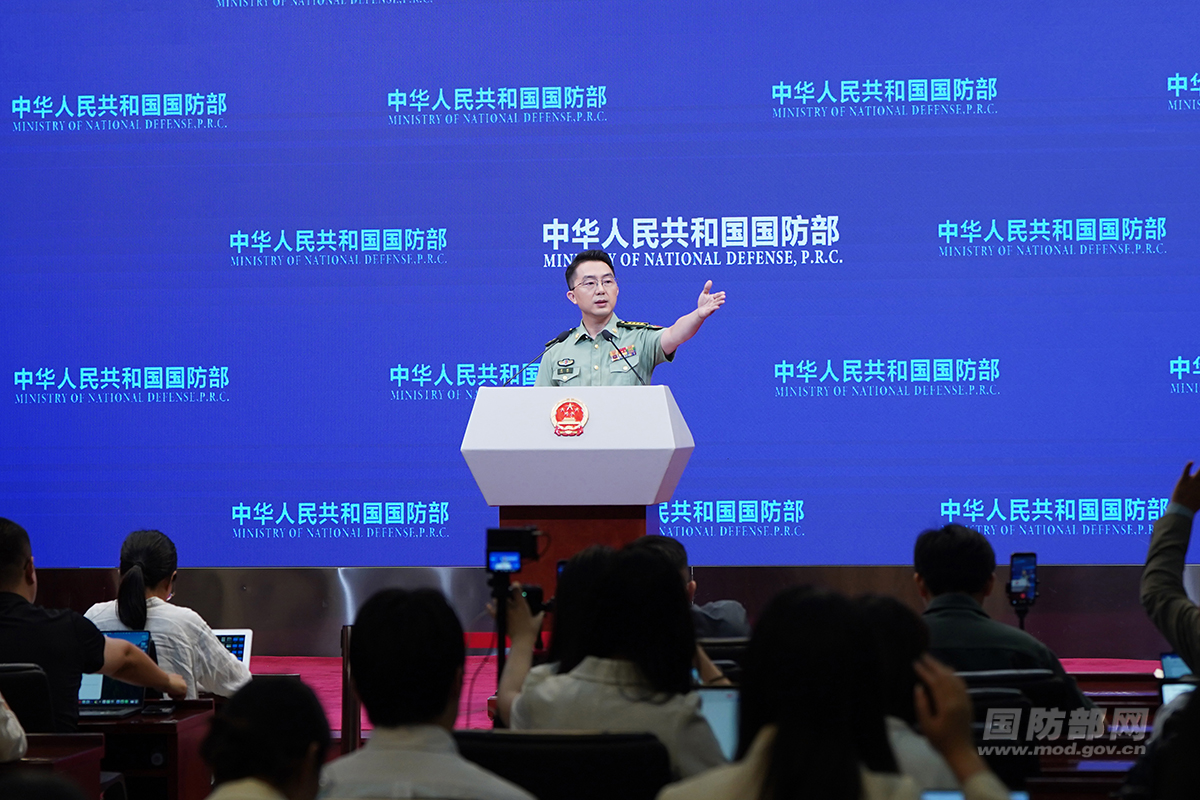
Senior Colonel Jiang Bin, spokesperson for the Ministry of National Defense (MND), answered questions at a regular press conference on the afternoon of July 30, 2026. (mod.gov.cn)
Journalist: Taiwan's military authorities claimed that on Monday, a PLA helicopter and a drone flew through the "restricted airspace" east of the "median line" of the Taiwan Strait for the first time, loitering in the area for over nine hours. Analysts on the island suggest the operation likely represents a "new modality of joint combat training" and a "pre-set battlefield rehearsal."
Jiang Bin: Taiwan is part of China's territory. There is no such thing as the so-called "median line" in the Taiwan Strait. The PLA's operations in the relevant waters and airspace are fully legitimate and necessary. The "Taiwan independence" separatist forces' attempt to designate a "restricted airspace" for the PLA is nothing but a bluff. It serves no purpose whatsoever.
Journalist: We see a growing trend of Middle Eastern nations seeking advanced defense technology from China, particularly in the fields of UAVs (drones) and satellite surveillance. What are the core principles of China's military-technical cooperation with the Middle East, especially with Iraq, and how does Beijing respond to claims that this cooperation is shifting the traditional balance of power in the region?
Jiang Bin: China and Iraq enjoy a sound tradition of military-to-military friendship and cooperation, including in academic and personnel exchanges. The Chinese side always adopts a prudent and responsible approach to military item exports, strictly adhering to the three principles guiding such exports. This stance not only helps enhance the legitimate self-defense capabilities of recipient countries but also contributes to regional and international peace, security, and stability. China never interferes in the internal affairs of recipient countries. As a friend and partner of Middle Eastern countries, China consistently upholds a fair and impartial position, actively working to promote peace talks. We stand ready to collaborate with the international community to restore peace and tranquility to the Middle East at an early date.
Journalist: Today marks the 27th anniversary of the signing of the memorandum between the governments of the PRC and Japan on the destruction of Japanese Abandoned Chemical Weapons (Japanese ACWs) in China. The Chinese side has requested the Japanese side to speed up the disposal of Japanese ACWs on multiple occasions. What is China's comment?
Jiang Bin: Abandoning chemical weapons in China is one of the heinous crimes committed by Japanese militarists during their war of aggression against China. To completely destroy all the Japanese ACWs at an early date is a historical, political and legal responsibility of Japan that is unshirkable. It is also an international obligation under the Chemical Weapons Convention. According to the provisions of the Convention and the memorandum between the Chinese and Japanese governments, Japan is required to complete the destruction of all ACWs in China by 2007. However, the Japanese side has been half-hearted in honoring its responsibility and delayed the destruction plan four times.
Due to the Japanese side's lack of sincerity and investment, in particular, not providing comprehensive, detailed and accurate information on the burial sites, a large number of ACWs remain undiscovered, posing a great danger to the safety of Chinese people and the ecological environment. Japan owes the Chinese people and the world an answer. There is no way for Japan to evade responsibility or muddle through. We once again urge the Japanese side to face squarely its historical and real-world responsibilities, take concrete measures to expedite the disposal process, and return Chinese people a clean land at an early date.
Journalist: The 2026 World Artificial Intelligence Conference (WAIC) was successfully held in China recently. Some analysts note that China is courting Global South countries to establish a China-led regulatory framework for military AI. This move is seen as an attempt to challenge U.S. dominance in the AI defense sector and impose rules designed to "constrain and restrict" American R&D efforts. What's your comment?
Jiang Bin: We firmly oppose overstretching the national security concept in the field of AI, politicizing and weaponizing AI, and triggering a new arms race in this domain. President Xi Jinping delivered a keynote address at the 2026 World Artificial Intelligence Conference & High-Level Meeting on Global AI Governance, elaborating on China's policy positions and philosophical propositions regarding AI development and governance in a comprehensive and systematic manner.
He stressed that all countries should take a people-centered approach and develop AI for the positive and for good. We should ensure that AI is an important driver for shared prosperity and common security. Representatives from around the world have witnessed firsthand China's impressive progress in applying AI extensively to drive development and improve people's livelihoods. As a responsible major country, China is committed to acting as a provider of global public goods in the AI field and advancing the building of a just and equitable system for global AI governance.
Journalist: The defense authorities of Taiwan are set to launch annual "Han Kuang" military exercises next week. What's your response to this move, and will the Chinese mainland take any countermeasures in response?
Jiang Bin: No matter how hard the DPP authorities try, their "Taiwan independence" separatist schemes are ultimately doomed to fail.
Journalist: Citing data from Taiwan's military authorities, as of 2025, over 4,000 troops opted to pay hefty early-discharge penalties rather than remain in service. Total compensation stands at around NT$920 million, and the top individual penalty exceeds NT$20 million. What's your comment on this?
Jiang Bin: This is nothing new. The louder the DPP authorities cry about their so-called "whole-of-society defense," the fewer people are willing to risk their lives for them. This is because a growing number of Taiwan compatriots have seen through the DPP authorities' true nature—seeking "independence" to provoke conflict, thereby bringing calamity upon Taiwan and its people. They are now speaking out against "Taiwan independence" with greater courage. Bound by shared blood ties and a common destiny, compatriots on both sides of the strait must stand together in solidarity, uphold the paramount national interest, and resolutely oppose separatist agendas. Only by doing so can we jointly safeguard peace and stability across the Taiwan Strait, advance the peaceful development of cross-strait relations, and realize the bright future of national reunification and rejuvenation.
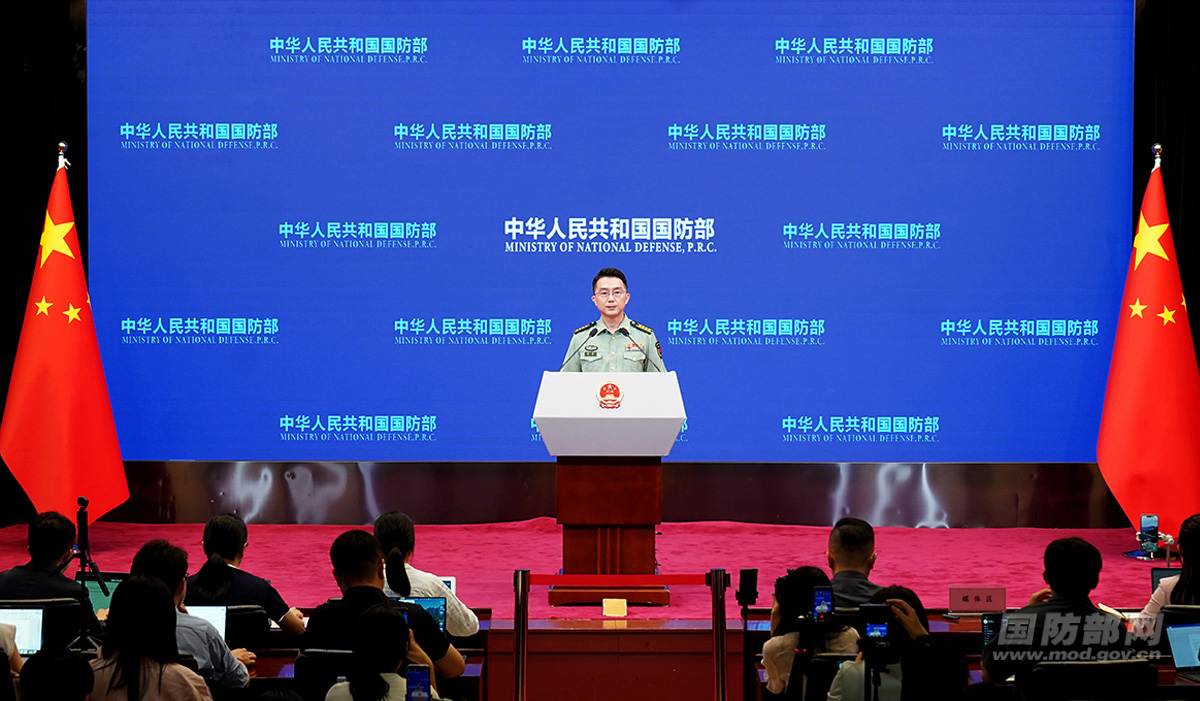
Senior Colonel Jiang Bin, spokesperson for the Ministry of National Defense (MND), answered questions at a regular press conference on the afternoon of July 30, 2026. (mod.gov.cn)
Journalist: From August 5 to 14, Taiwan's military will conduct the Han Kuang No. 42 exercises. For the first time, the drills will simulate a large-scale communications blackout as part of urban air defense and civil defense scenarios. During the exercise window, residents will face disruptions to navigation systems, mobile payment platforms, and other internet-dependent services. Observers on the island say the DPP authorities are using such scenarios to inflame anti-China sentiment and reinforce a narrative of alleged threats from the mainland. What's your comment?
Jiang Bin: The DPP authorities' insistence on "Taiwan independence" separatism will only undermine Taiwan's prosperity and the livelihoods of its people. Their true priority is their own selfish agenda — dragging people in Taiwan onto the "Taiwan independence" war chariot by stoking war fears and inflaming cross-strait confrontation. However, their separatist schemes are ultimately doomed to fail.
Journalist: Taiwan's military authorities have detected a total of 1,334 sorties by PLA aircraft and vessels operating near the Taiwan island in the first half of this year, marking the lowest recorded figure in three years. Some analysts have attributed this decline to the intensive high-level exchanges between China and the United States in recent months. What is your comment on this?
Jiang Bin: Taiwan is part of China. It is entirely lawful and beyond reproach for the PLA to conduct activities in relevant waters and airspace. The timing and mode of such operations are matters solely for China to arrange.
Journalist: On July 25, the China Coast Guard (CCG) spotted a Vietnamese vessel in distress in waters near the Nansha Qundao. It immediately rendered assistance, providing medical treatment to the injured and transferring rescued crew members to the Vietnamese side. The Vietnamese Ministry of Foreign Affairs has expressed appreciation for China's swift humanitarian assistance. Could you please share more information with us?
Jiang Bin: Media outlets have already covered the incident. Upon learning of the Vietnamese vessel in distress, Chinese forces—including units from the PLA Navy and the China Coast Guard—immediately launched rescue operations. To date, all 47 Vietnamese crew members have been rescued and transferred to the Vietnamese side. This rescue operation is a concrete manifestation of China's commitment to fostering a maritime community with a shared future. It also falls within our responsibilities to work with regional parties to build the South China Sea into a sea of peace, friendship, and cooperation.
Journalist: Foreign media reports claim the PLA has constructed full-scale replicas of key administrative complexes of the DPP authorities at a remote domestic testing range. The setup is designed to allow troops to drill in highly realistic scenarios, with analysts noting the unprecedented scale and specificity of the simulations. Responding to the reports, a spokesperson for Taiwan's defense authorities asserted that this underscores the severity of the "enemy threat" facing the island, while renewing calls for public backing of increased defense spending to resource military modernization and combat preparedness. What's your comment?
Jiang Bin: Our military trains under realistic combat scenarios to forge indomitable warfighting capabilities. We remain always ready and capable of fighting and winning. We will resolutely crush any separatist schemes, safeguarding national sovereignty and territorial integrity.
Jiang Bin: In just two days, we will celebrate the 99th Army Day of the PLA. Over the past century, we have stayed true to our original aspiration and are now marching steadily toward the centenary goal of building a world-class military.
Under the guidance of Xi Jinping Thinking on Strengthening the Military, all officers and soldiers are carrying forward the revolutionary spirit and answering the call to enhance combat readiness. With loyalty, we safeguard national sovereignty; with competence, we protect our people; and with responsibility, we contribute China's strength to global peace.
On this occasion, I would like to extend my warmest greetings to all comrades-in-arms.
