
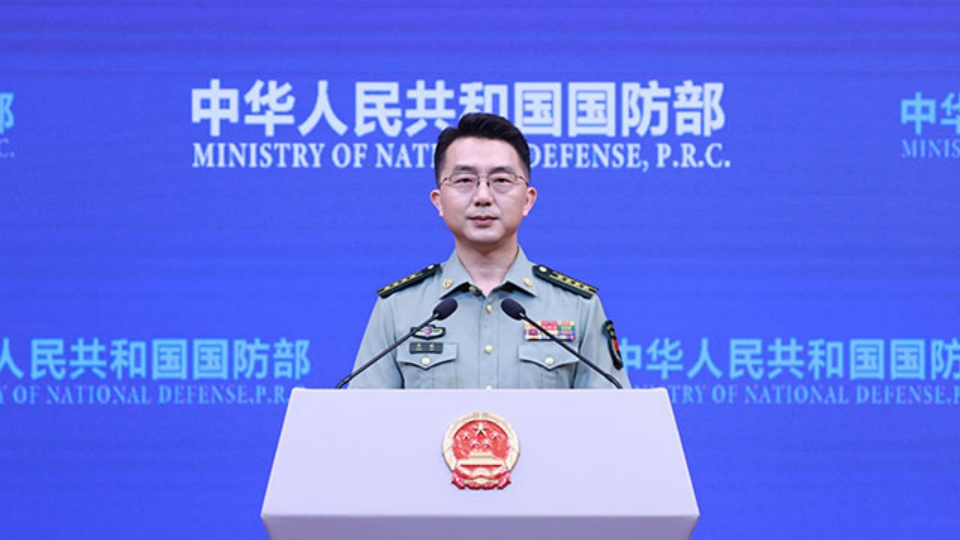
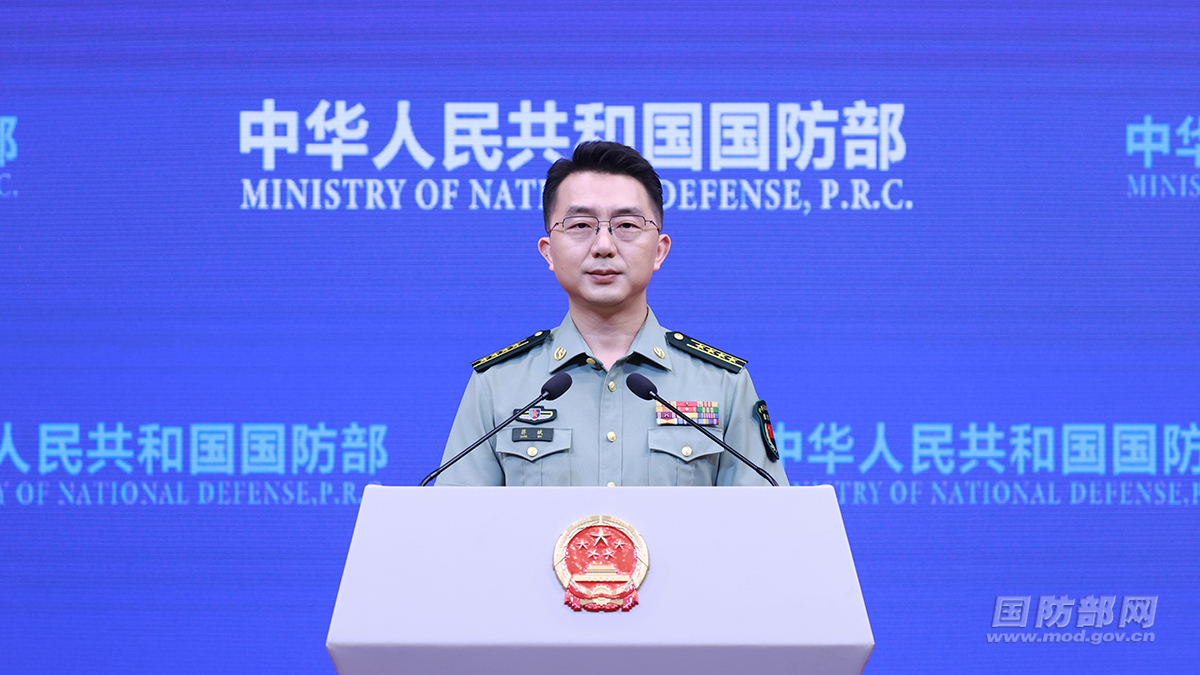
Senior Colonel Jiang Bin, spokesperson for the Ministry of National Defense (MND), answered questions at a regular press conference on the afternoon of May 28, 2026. (mod.gov.cn)
(The following English text is for reference. In case of any divergence of interpretation, the Chinese text shall prevail.)
Jiang Bin: Good afternoon. Welcome to the regular press conference of the Ministry of National Defense. I have no information to announce at the top. The floor is now open for questions.
Journalist: Chinese President Xi Jinping and Russian President Vladimir Putin held talks in Beijing recently. The joint statement released by China and Russia touched upon cooperation in the military domain. How will the Chinese side implement it?
Jiang Bin: This year marks the 30th year of the China-Russia strategic partnership of coordination and the 25th year of the signing of the China-Russia Treaty of Good-Neighborliness and Friendly Cooperation. President Xi Jinping and President Vladimir Putin met once again in Beijing to set new plans and arrangements for the development of China-Russia relations. As reaffirmed in the joint statement, the two sides will continue to consolidate traditional friendship between the two militaries, enhance military mutual trust, improve cooperation mechanisms, expand joint exercises and training as well as joint maritime and air patrols, and strengthen coordination within both bilateral and multilateral frameworks, so as to meet various risks and challenges together and jointly safeguard global and regional security and stability.
China-Russia military-to-military relations have all along been guided by the principle of non-alliance, non-confrontation and not targeting any third party. The Chinese military will work together with the Russian side to fully implement the important consensus between the two heads of state, continue to broaden and deepen cooperation, and render firm mutual support on issues involving each other's core interests and major concerns, so as to take bilateral military strategic coordination to new heights and make fresh contributions to global strategic stability and international fairness and justice.
Journalist: According to reports, recent media disclosures of the draft of the Sanae Takaichi administration's first Defense White Paper reveal that it frames China's activities in the Pacific as a "security threat" and expresses vigilance. Additionally, Japan's Chief Cabinet Secretary said that Japan's exclusively defense-oriented policy remains unchanged, so China's criticism regarding neo-militarism is completely off the mark. What is your comment?
Jiang Bin: What Japan does contradicts what it says. The more it tries to whitewash the inconsistency, the more obvious it gets. In recent years, the Japanese government has sharply hiked its defense budget, developed and deployed offensive weapons, eased restrictions on exporting lethal weapons, pushed to revise the pacifist Constitution, clamored to be a war-capable nation, and even touted abandoning the three non-nuclear principles. If these actions still qualify as "exclusively defense-oriented", then there would be no such word as offensive in dictionary. Japanese militarism once brought catastrophic disasters to the world and to Japan itself. Now the gray rhino of a remilitarized Japan is gathering speed, causing inevitable concerns and alarming many countries. The international community must see through Japan's "deceptive diplomacy" and "victim portrait", and work together to contain Japan's neo-militarism and safeguard peace and stability in the region and beyond.
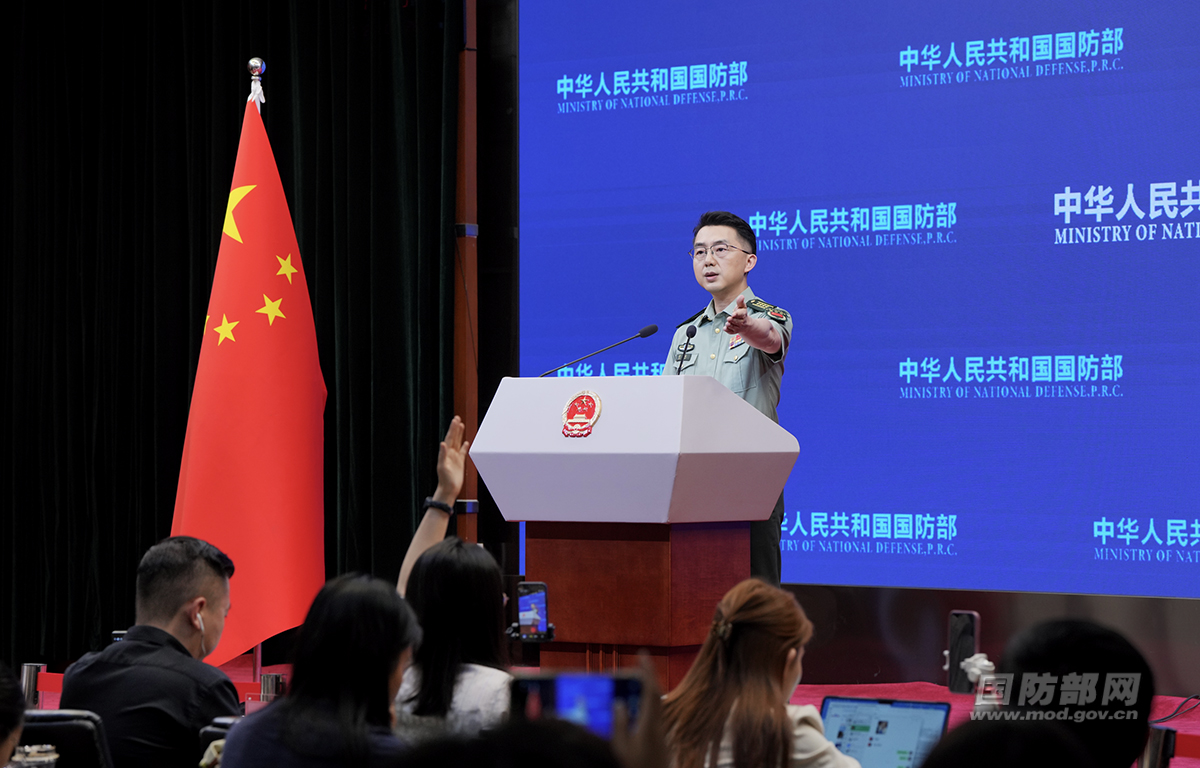
Senior Colonel Jiang Bin, spokesperson for the Ministry of National Defense (MND), answered questions at a regular press conference on the afternoon of May 28, 2026. (mod.gov.cn)
Journalist: Reports say that during his visit to China, U.S. President Trump said that he "is not looking to have somebody go independent", nor is he looking to "travel 9,500 miles to fight a war" for Taiwan. In response, Lai Ching-te disingenuously claimed that Taiwan will never become a "bargaining chip," while defending the status quo of the "Republic of China", and asserted that there is "no question of Taiwan independence". What is your comment?
Jiang Bin: "Taiwan independence" and peace across the Taiwan Strait are mutually incompatible. Safeguarding peace and stability in the Taiwan Strait represents the greatest common ground between China and the United States.
Lai Ching-te once blatantly labeled himself a "pragmatic worker for Taiwan independence". Now, he is hypocritically claiming that "there is no Taiwan independence issue"— a mere repackaging of his rhetoric after being harshly confronted by reality. This only shows that the pursuit of "Taiwan independence" has reached a dead end, and the illusion of seeking U.S. support for "Taiwan independence" is bound to be shattered.
Journalist: I have two questions. Firstly, it was reported that President Xi Jinping met with Pakistani Prime Minister Shehbaz Sharif during his visit to China. Additionally, General Zhang Shengmin, Vice Chairman of the Central Military Commission, met with Field Marshal Syed Asim Munir, Chief of Defense Forces and Chief of the Army Staff of the Pakistan Armed Forces, who visited China concurrently with the Prime Minister. How do you evaluate interactions and cooperation between the two countries and two militaries?
Secondly, reports say that the United States and Japan recently conducted joint drills in the southwestern islands of Japan, setting up a joint command center on an island just 110 km from Taiwan. Japan's Defense Minister openly framed the move as aimed at strengthening regional deterrence and operational capabilities for contingencies. What is your comment?
Jiang Bin: On your first question, China and Pakistan are good neighbors connected by the same mountains and rivers, good friends bound by trust, good partners watching out for each other, and good brothers sharing weal and woe. Since the establishment of diplomatic relations 75 years ago, the friendship between our two nations has stood the test of shifting international landscapes. It has grown stronger over time and taken deep root in the hearts of our peoples. Pakistani friends often describe China-Pakistan friendship as "higher than mountain, deeper than sea, and sweeter than honey", while the Chinese people affectionately refer to Pakistan as an "iron-clad brother".
China and Pakistan enjoy close military-to-military relationship. Fruitful outcomes have been witnessed in practical cooperation across areas such as strategic communication, joint exercises and training, personnel training, and equipment and technology. A series of flagship joint exercises—such as Exercise Warrior for the armies, Exercise Sea Guardian for the navies, and Exercise Shaheen for the air forces—have become signature programs for bilateral cooperation. We stand ready to work with Pakistan to follow the strategic guidance of our leaders, carry forward traditional friendship, strengthen strategic communication, enhance practical cooperation, firmly support each other on issues involving our core interests, so as to elevate our military-to-military relations to a higher level and jointly contribute to the building of an even closer China-Pakistan community with a shared future in the new era, as well as to global development and security.
On your second question, China advocates that defense and security cooperation between countries must not target any third party or harm the interests of any third party, still less undermine regional peace and stability. Japan's right-wing forces continue to take dangerous strides and engage in provocations in the military and security sphere. Its resurgent neo-militarism is poised to become a source of turmoil for East Asia. All peace-loving people should reject Japan's regressive course, preventing it from damaging regional peace and bring catastrophe upon the wider world once again.
Journalist: According to reports, the U.S. military plans to deploy the Typhon medium-range missile system at Kanoya Air Base in Kagoshima Prefecture, Japan, during the U.S.-Japan joint exercise from June to September this year. After the exercise, the system will be relocated to a U.S. military base in Japan. Once deployed, its range will be able to cover most of China's territory. What is your comment?
Jiang Bin: The Typhon medium-range missile system is an offensive weapon, and its deployment in Japan under the guise of joint exercise will undermine legitimate security interests of other countries, heighten the risks of arms races and military confrontation, and pose a grave threat to regional security and stability. We firmly oppose this. China urges the United States and Japan to earnestly respect the security concerns of countries in the region and stop undermining regional peace and stability.
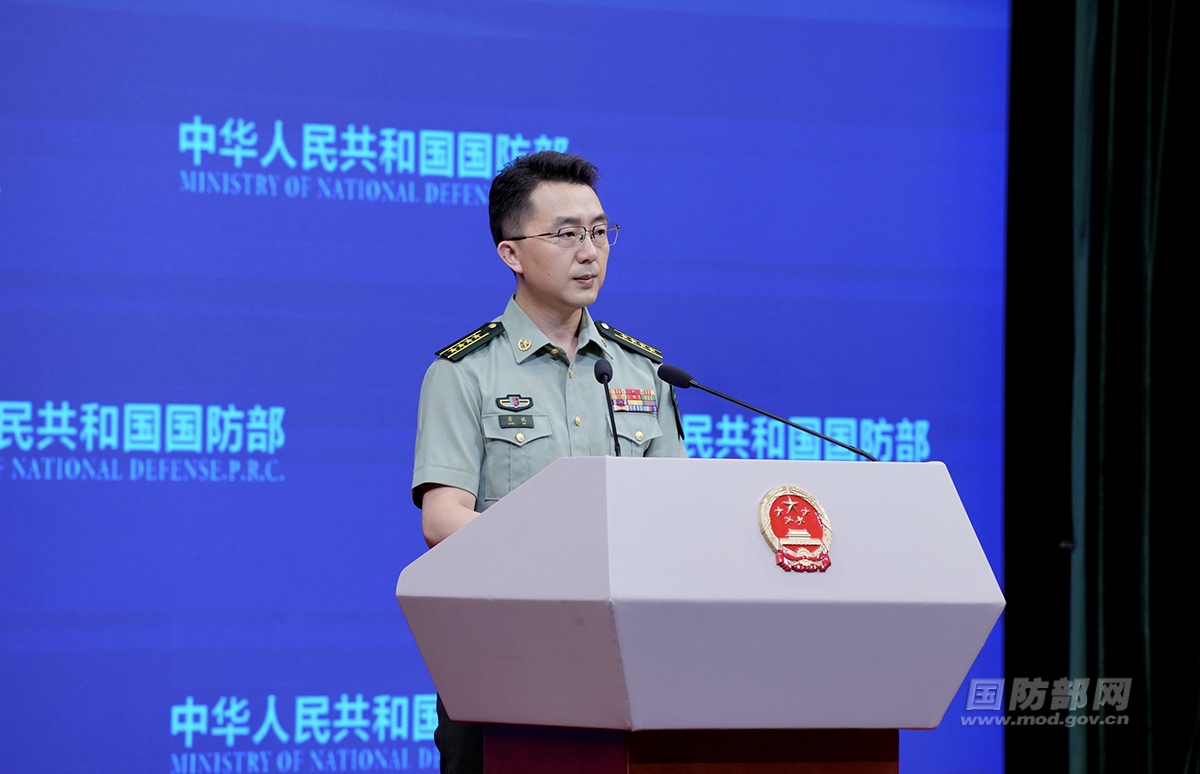
Senior Colonel Jiang Bin, spokesperson for the Ministry of National Defense (MND), answered questions at a regular press conference on the afternoon of May 28, 2026. (mod.gov.cn)
Journalist: I have two questions. First, it's reported that a Dutch military helicopter was "intercepted" by the Chinese military in the South China Sea yesterday. The PLA Southern Theater Command confirmed the incident on the same day. Do you have any comment on this? Second, U.S. officials said that the U.S. military launched a "self-defense strike" against Iran, shooting down multiple Iranian drones and striking a drone control station near Bandar Abbas. The U.S. military claimed that these assets posed a threat to U.S. forces and commercial traffic in the Strait of Hormuz. What's your comment on this?
Jiang Bin: On your first question, recently, a shipborne helicopter of the Dutch Navy frigate HNLMS De Ruyter illegally intruded into the airspace over China's Xisha Qundao. This act constitutes a serious violation of China's sovereignty and undermines China's security interests. The Chinese military sent naval and air assets to take forceful measures to warn off and expel the helicopter, and has lodged solemn representations with the Dutch side.
Xisha Qundao is China's inherent territory. The Chinese military remains on high alert at all times to resolutely defend national territorial sovereignty and maritime rights and interests. We urge the Dutch side to immediately cease its infringements, adventurism, and provocative actions, and to strictly discipline the operations of its frontline naval and air forces, so as to prevent unexpected incidents at sea and in the air.
On your second question, China has always maintained that dialogue and negotiation are the right way forward, and that the use of force leads nowhere. We urge relevant parties to honor the ceasefire commitments, remain committed to resolving disputes through peaceful means, continue seeking a solution through dialogue and negotiation that accommodates the legitimate concerns of all parties, and work for the early restoration of peace in the Gulf region and the Middle East.
Journalist: Who will China sent to attend this weekend's Shangri-La Dialogue in Singapore? The participant list released on the official website of the International Institute for Strategic Studies (IISS) does not include China's defense minister. Could you confirm this? Against the backdrop of the current international situation, what's China's view on the Shangri-La Dialogue as a platform for security summit?
Jiang Bin: From May 29 to 31, a delegation of experts and scholars from the PLA will travel to Singapore to attend the 23rd Shangri-La Dialogue at the invitation of the organizer. The delegation will be headed by Professor Meng Xiangqing of the National Defense University. Its members include experts and scholars from the National Defense University, the PLA Academy of Military Sciences, and the PLA Navy.
China attaches great importance to defense and security cooperation in the Asia‑Pacific region. We have all along upheld the principle of openness and inclusiveness, and taken an active part in constructive dialogues. The Chinese experts and scholars participating in this meeting will elaborate on China's ideas and initiatives, with a view to enhancing mutual trust, building consensus, deepening practical cooperation, and contributing China's wisdom and strength to safeguarding peace and stability in the Asia‑Pacific.
Journalist: Reports indicate that Japan's Ministry of Defense has unveiled measures to strengthen its defense capabilities in the space domain and has announced the activation of a low-Earth orbit military reconnaissance satellite constellation. What is your comment?
Jiang Bin: In recent years, Japan has went further down the path of military expansion, eroding the constraints of its pacifist Constitution step by step and aggressively building up military forces in outer space. The Japanese authorities continue to invest heavily in the space domain, conduct joint space-related military exercises with foreign countries, build a military intelligence system in space, and develop and deploy space weapons under the guise of "self-defense". These moves have increased the risks of space weaponization and arms race, exerting negative impacts on global strategic stability.
The peaceful use of outer space represents an universal consensus of humanity. The Japanese government's attempt to exploit the space domain to loose military restraints and to retrace the path of militarism runs counter to the historical and prevailing trend of our times. The international community must remain highly vigilant against this and take resolute measures to contain such moves, so as to firmly safeguard our common home.
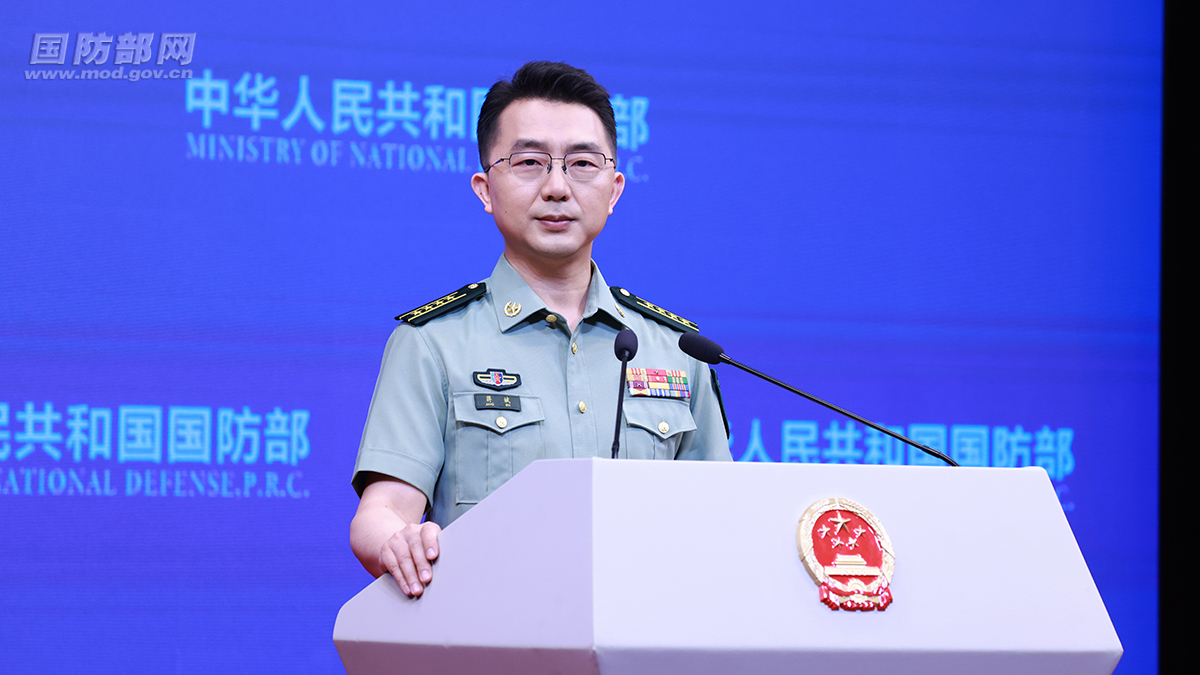
Senior Colonel Jiang Bin, spokesperson for the Ministry of National Defense (MND), answered questions at a regular press conference on the afternoon of May 28, 2026. (mod.gov.cn)
Journalist: President Xi Jinping recently held talks with Serbian President Aleksandar Vučić in Beijing. Could you please elaborate on the military-to-military engagement between China and Serbia?
Jiang Bin: China and Serbia are ironclad friends who have stood together through thick and thin and weathered storms side by side. Under the strategic guidance of the two heads of state, bilateral military cooperation—spanning high-level visits, personnel training and joint training—has continued to deepen. The Chinese military stands ready to work with the Serbian side to strengthen strategic communication, deepen practical cooperation, and render unequivocal support to each other's legitimate efforts in safeguarding core interests, oppose hegemony and bullying, write a new chapter of security and development, and make positive contributions to steadily advancing the building of a China-Serbia community with a shared future in the new era.
Journalist: According to reports, during U.S. Secretary of Defense Pete Hegseth's visit to China with President Trump, some media footages showed that he talked with Chinese Defense Minister Dong Jun. Can you brief us on what they discussed? In addition, there are reports that the U.S. Under Secretary of Defense for Policy will visit China in preparation for Hegseth's future visit. Can you confirm this?
Jiang Bin: During U.S. President Trump's visit to China, the defense leaders of China and the United States had a conversation on bilateral military-to-military relations and issues of common concern. Regarding future interactions between the two militaries, the two sides will make good use of dialogue and communication channels at various levels and jointly implement the important consensus reached by the two heads of state.
Journalist: The U.S. Acting Secretary of the Navy recently stated publicly that Washington is deferring a planned arms sale package to the Taiwan region worth approximately USD 14 billion, drawing close attention from observers on the island. Meanwhile, the U.S. House of Representatives has unveiled some contents of the Fiscal Year 2027 National Defense Authorization Act, which includes the "Taiwan Security Cooperation Initiative". With an allocation of USD 1 billion, the initiative is framed as assistance to bolster the so-called "defensive capabilities" of Taiwan. What's your comment on this?
Jiang Bin: China's position is consistent and unequivocal: we firmly oppose U.S. arms sales to China's Taiwan region. The U.S. side must abide by the one-China principle and the stipulations of the three China-U.S. Joint Communiqués, especially the August 17 Communiqué, faithfully implement the important common understandings reached between the two presidents, honor its commitments and public statements to China, and handle the Taiwan question with the utmost prudence. It should take concrete actions to keep bilateral and military-to-military relations on a stable, sound and sustainable track.
Journalist: The Japanese government plans to comprehensively ease restrictions on arms exports. At the same time, the Philippines is actively considering acquiring Abukuma-class frigates from the Japan Maritime Self-Defense Force. Several of these vessels retain the names of warships of the former Imperial Japanese Navy from World War II, many of which were involved in Japan's aggression against Southeast Asian countries. Do you have any comment on this?
Jiang Bin: China maintains that defense and security cooperation between relevant countries should neither target any third parties nor undermine their interests. During World War II, Japanese militarists carried out aggression and colonial rule against neighboring countries, including China and the Philippines, committing numerous atrocities such as the Nanjing Massacre, the Manila Massacre, and the Bataan Death March, for which Japan bears grave historical responsibility.
In recent years, Japan has departed from the constraints of its pacifist Constitution and the principle of exclusively defense-oriented policy, continuously exporting weapons and military equipment, and attempting to form "small cliques" to disrupt the South China Sea, thereby injecting destabilizing factors into the Asia-Pacific. We urge relevant countries not to forget these painful lessons of history, cease actions that fuel division and confrontation, and work together to curb Japan's "neo-militarism" so as to safeguard peace and stability in the Asia-Pacific region.
Journalist: On May 19, the PLA Navy sent a carrier task group led by PLANS Liaoning to relevant waters of the Western Pacific to conduct training on such subjects as live firing. It's a rare case that the training subjects were pre-announced. Observers suggest this exercise serves as a "major test" for the Liaoning carrier's new combat capabilities. What is your comment?
Jiang Bin: Regarding the training mission of the carrier task group led by PLANS Liaoning in the Western Pacific, we have already issued relevant information. It is a routine training organized in accordance with the annual plan. Since its commissioning, PLANS Liaoning has systematically organized a series of integrated drills. The carrier task group's training has been deepening and expanding toward far-seas operations, thereby establishing systemic combat capabilities. Serving as a "pathfinder" for China’s carrier program and an "incubator" for carrier-based talent, PLANS Liaoning has played an irreplaceable and pivotal role in enhancing the combat capabilities of the Chinese Navy. Moving forward, it will continue to contribute to the Chinese Navy's journey into the deep blue, safeguarding national sovereignty, security, and development interests, as well as maintaining world peace and stability.
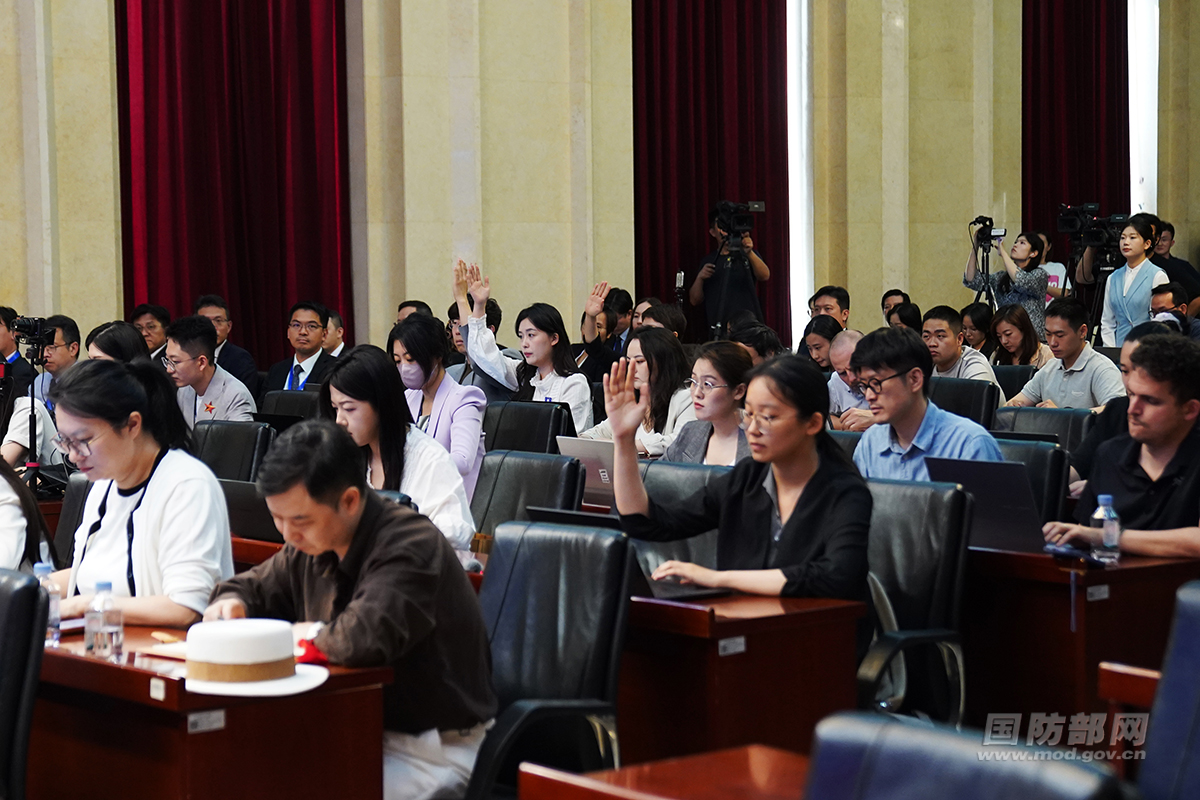
Journalists asked questions at a regular press conference on the afternoon of May 28, 2026. (mod.gov.cn)
Journalist: The chief of staff of the Armed Forces of the Philippines claimed that the Philippines faces "illegal, aggressive, deceptive, and bullying" actions. Filipinos should adopt a wartime mindset amid what he described as broader security threats. What's your comment?
Jiang Bin: Certain individuals in the Philippines have repeatedly peddled false narratives on China-related issues, severely eroding their own credibility. The Philippine side has frequently engaged in maritime provocations that infringe upon China's territorial sovereignty and maritime rights and interests, while colluding with external forces to stir up trouble in the South China Sea. Such actions constitute a serious violation of the Declaration on the Conduct of Parties in the South China Sea (DOC) and undermine the common interests of regional countries. Stirring up waves finds no popular support, and fabricating crises will gain no traction. In truth, those who concoct lies, stoke fear among the public, and inflame confrontation pose the real threat to the Philippines' national interests and the well-being of its people. We remain undaunted by turbulence on the seas, yet we hope for calm waters. China will continue to take effective measures to safeguard its legitimate rights and interests, as well as to uphold peace and stability in the region.
Journalist: Recently, when U.S. President Trump arrived in Beijing, a video clip captured a Chinese soldier who stood ramrod straight at his post despite the roaring pass of the Air Force One behind him. The clip has spread widely across social media both at home and abroad, with many netizens praising the soldier's iron discipline. Do you have any comment on this?
Jiang Bin: That sentinel who stood straight is a microcosm of the millions of Chinese service members. He vividly embodies the confidence, strength, and composure of a major country's military. Swift as a thunderbolt when called to action, immovable as a mountain when holding position—the PLA remains a heroic force in which the Party and the people can place absolute trust at all times.
Journalist: I have two questions. First, this month, at the opening ceremony of the Northeast Super League, scale models of J-35 and J-6 fighter jets hand-built by aviation enthusiasts "soared" over the stadium, drawing cheers from the crowd. The appearance of both Shenyang Aircraft Corporation's veteran workhorse and its new ace fighter sparked widespread online admiration for how rapidly China's strategic aviation assets are advancing. Do you have any comment on this? Second, according to reports, during a phone call between the U.S. and Japanese defense leaders, the U.S. informed Japan that the delivery of the 400 Tomahawk missiles ordered by Japan in 2024 would be significantly delayed, with some deliveries potentially postponed by as long as two years. Japanese analysts believe the delay will push Japan to accelerate the mass production of domestically developed missiles. What is your comment?
Jiang Bin: On your first question, I have noted the reports about the opening ceremony of the Northeast Super League. This reflects the people's most sincere affection for national defense. I would also like to extend my best wishes to the players of the Northeast Super League: May your footwork as precise as aircraft assembly, your shots as powerful as an afterburners firing, and may you carry forward aviation professionals' spirit of perseverance, tenacity, and striving for excellence to achieve great success on the green field.
On your second question, we hope that military cooperation between relevant countries will contribute to regional peace and stability, rather than the opposite.
Jiang Bin: If there are no further questions, this concludes today's press conference. Thank you.
