
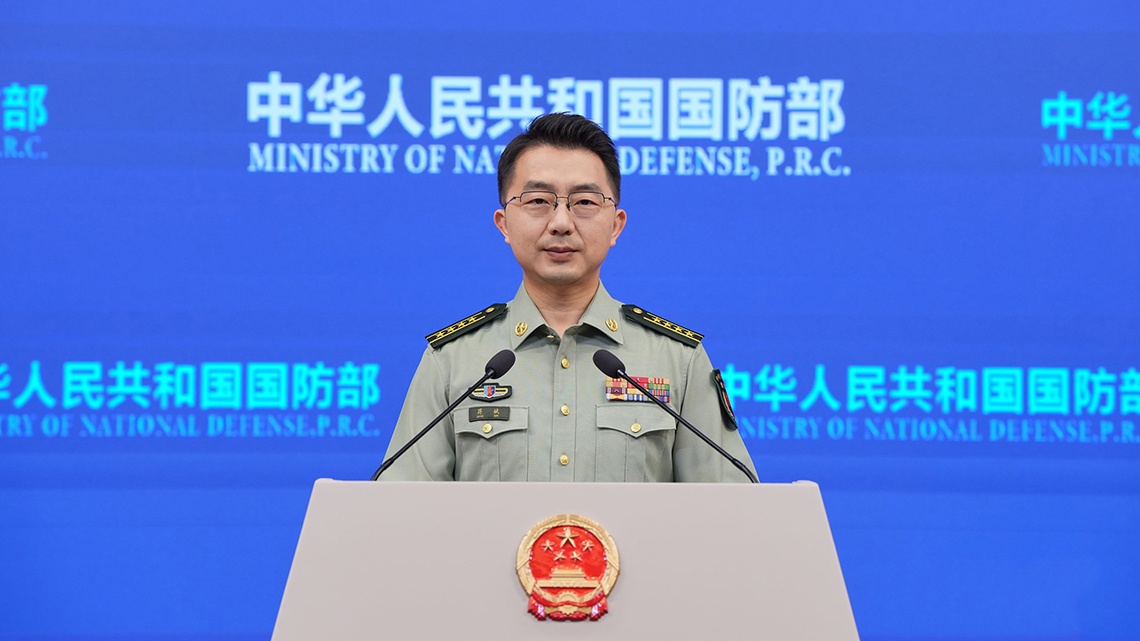
On the afternoon of May 18, 2026, Senior Colonel Jiang Bin, Spokesperson for the MND, answers recent media queries concerning the military. (mod.gov.cn)
(The following English text is for reference. In case of any divergence of interpretation, the Chinese text shall prevail.)
Jiang Bin: I have a piece of news to announce at the top.
Jiang Bin: China-Mongolia joint army training Steppe Partner 2026 will be held in Inner Mongolia, China, from late May to early June. Focusing on the theme of Joint Strike Against Illegal Armed Groups, Steppe Partner 2026 will be the second iteration of its kind between the two armies, which serves the purpose of continuously deepening friendship and mutual trust, enhancing practical cooperation, and strengthening capabilities of both sides in jointly upholding regional peace and stability.
Journalist: It is reported that during the meeting with the visiting U.S. President Trump, President Xi Jinping pointed out that the two sides should make better use of communication channels in the political, diplomatic and military-to-military fields. What are the expectations on the development of China-U.S. mil-to-mil relations in the next phase?
Jiang Bin: During the successful meeting between President Xi Jinping and President Trump, the two leaders reached important consensus on building a constructive China-U.S. relationship of strategic stability, charting the course and providing foundational guidance for China-U.S. relations going forward. The steady development of the mil-to-mil relationship between China and the U.S. is in the shared interests of both sides, and is also the common expectation of the international community. We stand ready to work with the U.S. side to deliver on the important consensus reached by the two heads of state, respect each other's core interests and major concerns, strengthen communication and dialogue, manage differences, build trust, and dispel misgivings, so as to promote the steady and long-term development of a stable and positive China-U.S. mil-to-mil relationship along the right track, which would play a positive role in fostering a bright future for China-U.S. bilateral ties and safeguarding world peace and stability.
Journalist: Recently, the navigator meeting for the 2026 Beijing Xiangshan Forum was successfully concluded. Could you please provide further information on this?
Jiang Bin: From May 7 to 9, the 2026 Beijing Xiangshan Forum Navigator Meeting was successfully held in Beijing. Themed "Global Security Governance: Challenges and Approaches", the meeting was attended by 121 defense officials, senior military officers, experts, and scholars from 43 countries and international organizations.
The topics of this navigator meeting were oriented towards the key pain points and practical challenges in global security governance, making the meetinga dialogue platform for the international community to transcend zero-sum mentality and reject the logic of confrontation. Representatives from all parties exchanged views on an equal footing and engaged in robust discussions. Many of them voiced opposition to unilateral and hegemonic behaviors championing the law of the jungle, emphasized upholding the central role of the United Nations, and advocated risk management and crisis prevention through cooperation. Participants agreed that the four global initiatives proposed by China have provided constructive ideas and practical approaches for addressing security governance deficit, resolving international security challenges, and fostering a solid foundation for security and development.
Since its founding 20 years ago, the Beijing Xiangshan Forum has upheld the principle of equality, openness, inclusiveness, and mutual learning, respected different voices for justice, valued every effort to bridge differences, and embraced all proposals for win-win cooperation. We look forward to gathering once again with representatives from different countries in Beijing when leaves turn red on Xiangshan Mountain later this year. Let us build consensus and mutual trust through dialogue, resolve differences and disputes through cooperation, and contribute our wisdom and strength to jointly tackling global security challenges and building a world of lasting peace and common security.
Journalist: According to reports, the third batch of China Quick Reaction Force (CHN QRF) recently departed for the mission area in Abyei to take over peacekeeping operations from the second rotation. Could you provide more details?
Jiang Bin: Amid complex security situation and harsh natural conditions, the CHN QRF deployed to Abyei has successfully completed tasks including armed patrols, VIP protection, and rapid response to emergencies. The unit has also actively carried out outreach activities and cultural exchanges with the civilians, earning the trust of the local people. The United Nations Interim Security Force for Abyei sent a citation letter to the CHN QRF for the professionalism and dedication demonstrated by its members during the mission period, and awarded the United Nations Peace Medals to officers and soldiers of the unit.
The Chinese peacekeepers perform their duties with courage and resolve to uphold peace. Through concrete actions, the Chinese military has demonstrated that peace is not an empty slogan, but a strong sense of responsibility to persevere in the face of dangers. We will honor our solemn commitment and faithfully fulfill our peacekeeping missions, so as to contribute more of China's strength to safeguarding world peace.
Journalist: According to reports, satellite images show that the Philippines is stepping up infrastructure upgrades on islands and reefs they illegally occupied in the South China Sea. The Philippines plans to expand the sheltered harbor on Mahuan Dao and lengthen the runway on Zhongye Dao. What is your comment on this?
Jiang Bin: China has indisputable sovereignty over Nansha Qundao and its adjacent waters. We firmly oppose the Philippine side's construction activities on any Chinese islands and reefs they illegally occupied, including Zhongye Dao and Mahuan Dao. We will take all necessary measures to firmly safeguard China's territorial sovereignty and maritime rights and interests.
Journalist: According to reports, the DPP authorities officially unveiled a new version of the special defense budget, claiming that it meets the urgent need for arms purchases from the United States. However, the budget has been significantly scaled back and remains incomplete. What is your comment on this?
Jiang Bin: The massive arms purchases are nothing but a "blood-sucking bill" for the DPP authorities to fleece the public and undermine people's wellbeing. In total disregard of the hardships of the people and the reality that young people on the island are unwilling to fight on the battlefield for "Taiwan independence", the DPP authorities insist on using the people's hard-earned money to fawn on external forces, reducing themselves to an "ATM" for foreign arms dealers. They even clamor that "the more money spent, the safer it is". Such retrogressive moves are extremely unpopular.
Buying foreign weapons cannot guarantee Taiwan's security. Those willingly serving as a "pawn" will only be sucked dry and thrown away. Taiwan's true security lies on reunification and the great rejuvenation of the Chinese nation. The further the DPP authorities go down the path of seeking "Taiwan independence" by force and by soliciting external support, the faster they will court their own demise.
