
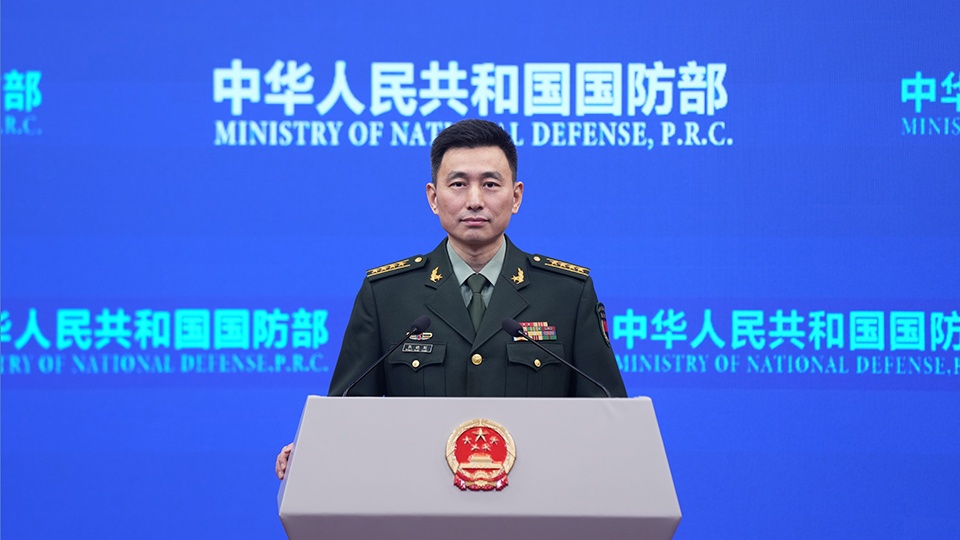
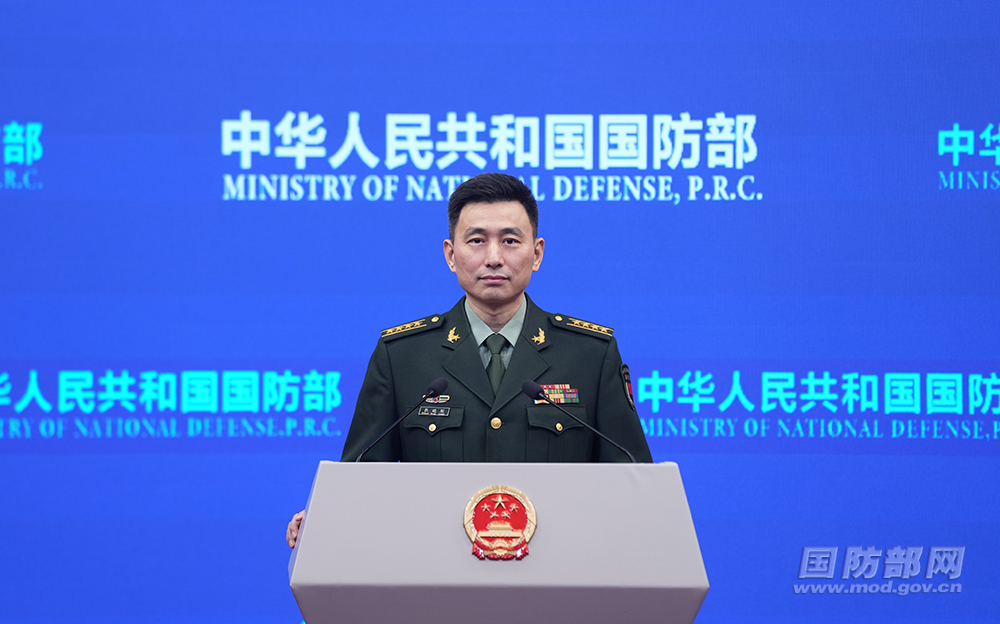
Senior Colonel Zhang Xiaogang, spokesperson for the Ministry of National Defense (MND), answered questions at a regular press conference on the afternoon of December 25, 2025. (mod.gov.cn)
(The following English text is for reference. In case of any divergence of interpretation, the Chinese text shall prevail.)
Zhang Xiaogang: Good afternoon everyone. Welcome to the regular press conference of the Ministry of National Defense. Today, I have no information to announce at the top. The floor is now open for questions.
Journalist: China's international military cooperation in 2025 is impressive. Can you further brief us on that?
Zhang Xiaogang: This year, with a pioneering spirit and proactive efforts, work related to China's military diplomacy has been conducted in a way that kept in alignment with the overall work of the Party and the state, adhered to the strategic guidance of head-of-state diplomacy, and focused on contributing to the improvement of combat readiness.
Firstly, we have strengthened strategic communication with countries including Russia, the US, and European countries. A Vice Chairman of the CMC visited Russia upon invitation. The Defense Minister had virtual and in-person meetings with the US Secretary of War, and paid visits to France and Germany. China and Indonesia held the first Joint Foreign and Defense Ministerial Dialogue under the 2+2 mechanism. Senior military leaders of China and the UK held bilateral talks. We have deepened institutional consultations with defense authorities of several countries. All these efforts have strengthened China's defense ties with other countries and fostered a more favorable strategic security environment.
Secondly, we successfully hosted the SCO Defense Ministers' Meeting, the China-LAC States Defense Forum, and the inaugural Young Leaders Conference of the China-Africa Peace and Security Forum in China. At the UN Peacekeeping Ministerial, China put forward proposals in support of the reform and transformation of UNPKOs. The Beijing Xiangshan Forum has become more attractive and influential. Multilateral military diplomacy builds consensus and sends out the voice of the Chinese military.
Thirdly, the joint exercises and training with foreign militaries featured many highlights. These include China-Russia joint naval exercise and joint aerial strategic patrol, China-Malaysia Aman Youyi joint exercise, China-Egypt Eagles of Civilization joint air force training, and China-Serbia Peace Guardian joint army training. Through these realistic exercises and training, we have enhanced our capabilities to jointly respond to security challenges.
Fourthly, we responded to violations and provocations made by relevant countries concerning Taiwan and the South China Sea with timely diplomatic representations and press releases to counter misinformation and defend national interests. The MND increased the frequency of press releases, expanded media participation, and launched an account on the X platform to help overseas audiences to get better access to information on the Chinese military.
In the coming year, we will thoroughly implement Xi Jinping Thought on Strengthening the Military and Xi Jinping Thought on Diplomacy, actively practice the four major global initiatives, and promote high-quality development of international military cooperation, so as to provide support for achieving the military's centenary goal and to open a new chapter in major-country military diplomacy with Chinese characteristics.
Journalist: According to media reports, regarding the introduction of nuclear-powered submarines, Japanese Prime Minister Sanae Takaichi said, "We will not rule out all options." An official from the Prime Minister's Office stated that Japan should possess nuclear weapons. Additionally, the Japanese Ministry of Defense recently released a report, claiming that China's defense spending is growing rapidly and China is increasing activities near Japan. The report also laid out a plan to deploy mobile radar equipment in Okinawa by 2026 to monitor Chinese military activities, including those of the Chinese aircraft carriers. What's your comment on that?
Zhang Xiaogang: China's defense expenditure is reasonable, moderate, and remains below the global average as a share of GDP. The operations of the Chinese military in relevant waters are fully in compliance with international law and practice, and brook no interference or provocation. We urge Japan to cease its false narratives and halt targeted deployments against China. We will take resolute countermeasures against any harassment or provocation.
In recent years, Japan has relentlessly pursued remilitarization and accelerated its military buildup, with an increasingly visible and dangerous tendency towards a militarist revival. To cover up its underlying ambitions, Japan has repeatedly used China as a pretext. Not long ago, Japanese Prime Minister Sanae Takaichi made erroneous remarks concerning the Taiwan question. Now, right-wing forces in Japan have thrown away their hypocritical mask and are openly advocating for nuclear armament. These actions constitute a direct defiance of international norms, a blatant challenge to the bottom line of international justice, the post-WWII international order, and the global non-proliferation regime. They pose a severe threat to peace and stability in the region and beyond. What Japan is doing runs directly counter to its own professed commitment to peaceful development. We call upon all peace-loving nations and peoples to take action to resolutely contain the revival of militarism by Japan's right-wing forces, and prevent the world from sliding into turmoil or reliving tragedies of the past.
Journalist: Since the beginning of this year, the PLA has taken solid steps in carrying out military training, making an all-out effort to achieve the military's centenary goal. Please provide more information about it.
Zhang Xiaogang: In 2025, the PLA has thoroughly followed Xi Jinping Thought on Strengthening the Military, implemented the military strategy for the new era, and striven to achieve the military's centenary goal. Through faster-paced training transformation and realistic training on a larger scale, the PLA has been developing its military training by prioritizing combat readiness, advancing joint operations, and pursuing innovations.
Firstly, the PLA has introduced and promoted a centralized and specialized model for basic training. We conducted widely-participated competitions and strengthened training under realistic, complex and extreme conditions. Military personnel's combat skills have been effectively enhanced.
Secondly, priorities have been placed on command and control training, and on training based on realistic operational plans. We have enhanced specialized and intensive training and conducted training for emergency response. This is aimed at optimizing and closing the kill chain, advancing cross-domain force integration, and honing integrated joint operational capabilities.
Thirdly, we have enriched training methods by integrating technology (a "technology+" approach) and conducted extensive training by utilizing training bases, simulation systems, and network platforms. Priorities have been placed on the training of new equipment and new forces, so that new-quality combat forces such as unmanned, cyberspace and electromagnetic forces become operational and integrated.
Fourthly, we have conducted over 20 joint exercises, training, and competitions with foreign militaries. These activities have strengthened training exchange and cooperation between China and other nations, contributing to international military cooperation.
Journalist: I have two questions. First, the US recently announced that the 19th US-China Defense Policy Coordination Talks were held from December 15 to 16. The US side stressed that America's interest in the Indo-Pacific are significant and it stands ready to defend them. Could you please brief us more on that? Did the two sides clarify specific plans and arrangements for military-to-military engagement next year? The second question is that the US President recently signed the National Defense Authorization Act for Fiscal Year 2026, which contains a number of China-related provisions. Notably, it allocates approximately US$1 billion to the "Taiwan Security Cooperation Initiative" to strengthen arms sales to Taiwan. What's your comment on that?
Zhang Xiaogang: On your first question, China has its principle in developing military relations with the US. That is, China's sovereignty, dignity and core interests brook no infringement. The US talks a lot about engaging with China. At the same time, it keeps undermining China's sovereignty and security. This two-faced approach—saying nice words but doing bad things—is very hypocritical and will not work on China. Challenging China's red lines and bottom lines will come at a cost. We urge the US side to immediately correct its wrongdoings, stop all infringements and provocations, and do not challenge China's resolve in safeguarding our sovereign rights and interests.
On your second question, the negative provisions in the US Act concerning Taiwan grossly interfere in China's internal affairs. They have sent extremely wrong signals to the "Taiwan independence" separatist forces and seriously undermined peace and stability across the Taiwan Strait. The US side has violated its commitments by increasing arms sales to Taiwan. This will only embolden the "Taiwan independence" separatist forces, and push the Taiwan Strait closer to the abyss of military conflict. The DPP authorities are letting the US to exploit and exhaust the island at the cost of the well-being of the people in Taiwan.
Using Taiwan to contain China is doomed to fail, and seeking independence by force is a path to self-destruction. We urge the US side to fully recognize the sensitivity of the Taiwan question, strictly observe the one-China principle and the three China-US joint communiqués, exercise utmost caution in handling Taiwan-related matters, stop arming Taiwan in any form, and take concrete actions to maintain the overall stability of state-to-state and military-to-military relations between China and the US.
Journalist: Recently, the General Office of the State Council and the General Office of the Central Military Commission issued the Regulation on Military Service Registration, which will come into effect on January 1, 2026. Please tell us more about that.
Zhang Xiaogang: Military service registration is an important institutional arrangement in China's military service system, through which the Chinese citizens fulfill their military service obligations in accordance with the law. The Military Service Law, revised in 2021, made specific adjustments and reforms to the registration system. The formulation and issuance of the Regulation on Military Service Registration is a concrete step to implement the law. The regulation covers five main aspects.
Firstly, it clarifies the responsibilities of the military and civil authorities. Vertically, it delineates the duties at the provincial, municipal, county and township levels. Horizontally, it clarifies the working relationships among the military, military service agencies of local people's governments at or above the county level, and other related government agencies. This builds an organizational and managing system characterized by demand-driven orientation, civil-military coordination, and law-based implementation.
Secondly, it defines the scope of registration subjects. Adhering to the principle of precise registration based on needs, the regulation details the eligibility for initial military service registration and reserve service registration. It also clarifies regulations on reserve registration of female citizens.
Thirdly, it standardizes registration procedures and methods. Focusing on information-driven support, close civil-military collaboration, and convenience and efficiency, it distinguishes between initial registration and reserve registration, and optimizes the system design regarding registration timing, location, content, methods, and conclusions.
Fourthly, it improves the verification and inspection mechanism. To ensure timely data updates, it specifies key subjects for information verification, procedures for changing registration information, and the timing and methods for registration inspections.
Fifthly, it refines relevant supporting measures. The regulation stipulates publicity and education, IT infrastructure development, registration announcement, funding guarantees and disciplinary measures regarding military service registration.
The release and implementation of the regulation will standardize military service registration and effectively ensure that citizens fulfill their military service obligations in accordance with the law.
Journalist: According to reports, Lai Ching-te stated in a media interview the need to "seek peace through strength", reiterated that the relationship between the US and Taiwan is "as solid as a rock", and promoted a $40 billion arms procurement. The head of Taiwan authorities'defense department also claimed that the US emphasizes the shared responsibilities of allies in defense, and that Taiwan must continue to promote a "special defense budget" to demonstrate its determination for self-defense. Please comment on that.
Zhang Xiaogang: The root cause of the current cross-strait tensions and instabilities lies in the DPP authorities' provocative pursuit of "Taiwan independence" in collusion with external forces. Lai Ching-te, with his unprincipled subservience to the US, reckless militarization, and escalation of cross-strait confrontation, is an out-and-out saboteur of peace and instigator of war. Therefore shame on him that he talked about "peace", and his empty boast of "strength" was ignorant. It is little more than overestimating and deceiving himself. We sternly warn the DPP authorities that national reunification is unstoppable. Those who act as pawns will inevitably be discarded and those who betray the nation and engage in secession will be nailed to the pillar of historical shame.
Journalist: I have two questions. Firstly, it was reported that the Taiwan authorities' security bureau recently stated that around 3,600 sorties of PLA aircraft had been detected around the island this year, setting a new record. PLA aircraft and ships had conducted 39 joint combat readiness patrols. In response, Taiwan authorities' defense department claimed to have formulated contingency procedures in response to mainland military operations and said they were prepared to counter potential PLA surprise attacks.Please comment on that.
My second question: This year marks the 80th anniversary of the victory of the Chinese People's War of Resistance Against Japanese Aggression and the World Anti-Fascist War. According to reports, media investigations conducted over several months have revealed that many "peace" museums across Japan are quietly shifting direction—exhibits that reveal Japan's history of aggression and expose the truth of the war are being deliberately downplayed, reduced, or even removed. Very few venues now systematically and objectively present Japan's history as a perpetrator of war crimes. Please comment on that.
Zhang Xiaogang: On your first question, Taiwan is an inalienable part of China's territory. The PLA's regular training and combat readiness exercises around the Taiwan island, as well as the operations to counter separatism and foreign interference, are entirely justified, necessary, and legitimate, with an aim to safeguard national sovereignty and territorial integrity. The PLA will relentlessly combat separatist activities to advance the cause of reunification. For every provocation made by the "Taiwan independence" forces, we will respond by increasing pressure and pushing forward resolutely until the complete reunification of the motherland is achieved. We sternly urge the DPP authorities to face reality, follow the overwhelming trend of the times, abandon their separatist schemes of "Taiwan independence" once and for all and cease all provocative actions that could lead to conflicts. This is the only correct choice.
On your second question, the history of Japanese militarist aggression is an indisputable fact and its heinous crimes cannot be concealed. How Japan treats this part of history serves as a litmus test for its moral conscience and genuine commitment to peace. We therefore urge Japan to cease its evasion, obfuscation, and deception, and sincerely apologize and genuinely atone for its crimes. Only by taking such actions can it truly earn the trust of its Asian neighbors and the wider international community.
Journalist: According to media reports, Japan claims to have made substantive progress in technologies that could disrupt satellites of other nations. It plans to reorganize its Air Self-Defense Force into the Air and Space Self-Defense Force and to construct a spacecraft carrier in fiscal year 2026. Some media analysis suggests that vigilance is needed, as Japan may be planning a Pearl Harbor incident in space. What is your comment?
Zhang Xiaogang: Maintaining lasting peace and security in space is vital to the security, development, and prosperity of all nations. Japan's unrestrained development of satellite disruption technology is accelerating the weaponization and militarization of space, and fueling a space arms race. It is extremely dangerous and unpopular. Given that Japan's vicious militarists once launched sneak attacks and that the country is now taking an offensive space policy, it is hardly surprising that there are growing concerns about another Pearl Harbor scenario.
Journalist: The US Department of War recently released Annual Report to Congress: Military and Security Developments Involving the PRC. Please comment on that.
Zhang Xiaogang: Year after year, the US releases such reports, which grossly interfere in China's internal affairs, deliberately misrepresent China's national defense policy, groundlessly speculate on China's military development, and smear the routine activities of the Chinese military. Filled with wrong perceptions of China and geopolitical prejudices, these reports hyped up the so-called China's military threat to mislead the international community. We express strong dissatisfaction and resolute opposition.
China steadfastly pursues a defensive national defense policy, adheres to the military strategy of active defense, and advances the modernization of national defense and armed forces with high quality. These efforts are solely aimed at safeguarding national sovereignty, security and development interests. China has always been a force for peace, stability and progress in the world. The Chinese military actively implements the Global Security Initiative, acts in strict compliance with domestic and international laws, safeguards its legitimate rights and interests in a reasonable and measured manner, endeavors to provide international public security goods, and works with other militaries to foster the building of a community with a shared future for humanity.
Taiwan is China's Taiwan and resolving the Taiwan question is a matter for the Chinese people. The PLA defends national sovereignty and territorial integrity. Its efforts to combat separatist activities and promote reunification are entirely justified and unwavering. The US has no right to interfere. China has indisputable sovereignty over the South China Sea islands and reefs and their adjacent waters. While certain countries within the region have infringed upon and provoked China and external forces have meddled in the situation and stirred up trouble, China's resolute defense of its territorial sovereignty and maritime rights and interests is legitimate, lawful, rational and restrained. It is worth pointing out that the US has deliberately rallied its allies to send naval and air forces to China's doorstep for close-in harassment. The necessary measures taken by the Chinese military in response are beyond reproach. The fundamental solution to avoiding maritime and air incidents is for the US and its allies to cease all dangerous and provocative actions. We urge the US to adopt a correct perception of China, view China and the development of the Chinese military objectively, stop fabricating false narratives, cease stoking division and confrontation, and avoid leading the state-to-state and military-to-military relations astray.
Journalist: According to US media reports, the PLA would "attack Taiwan" in three steps, listing the so-called optimal attack timing and optimal landing sites. Recently exposed details from a classified US Department of War report suggest that the mainland could destroy advanced US weapons before they reach Taiwan, indicating that the US is no longer capable of "defending Taiwan". Please comment on that.
Zhang Xiaogang: Certain media outlets have speculated about the operations of the PLA with ulterior motives, fueling unwarranted "war anxiety", which only undermines peace and stability across the Taiwan Strait. The Taiwan question is purely China's internal affair, which brooks no foreign interference. We are willing to strive for the prospect of peaceful reunification with the greatest sincerity and utmost effort, but we will never promise to renounce the use of force and reserve the option to take all necessary measures. Should "Taiwan independence" separatist forces provoke and even cross the red line, we will have no choice but to take resolute and decisive actions. The PLA stands ready at all times to fight and win, and will resolutely defeat any schemes for "Taiwan independence" or any form of external interference.
Journalist: It was reported that the Japanese government is planning to request a record-high defense budget exceeding 9 trillion yen for the next fiscal year. The budget will include plans to deploy long-range missiles, reorganize the Japan Self-Defense Force (JSDF), and boost its operational capabilities in space. What's your comment on that?
Zhang Xiaogang: It is well known that the Potsdam Proclamation made it clear that Japanese militarism and its soil must be mercilessly and permanently eradicated. A new order of peace, security, and justice can only be established by restricting Japan's right to wage war politically and legally, and by eliminating the ideological roots for war in Japan. Japan should be completely disarmed and must not maintain industries that could lead to its rearmament. The Japanese Instrument of Surrender pledged to "carry out the provisions of the Potsdam Declaration in good faith." These promises were made in black and white and they still ring loud and clear. However, Japan has now openly abandoned its obligations under international law and violated the provisions of its own Constitution and political commitments by substantially increasing its defense budget, and engaging in military expansion and war preparations. Where is Japan's credibility? And what does Japan intend to do?
In fact, after WWII, the Japanese government failed to completely shut out militarism. The right-wing forces have never sincerely reflected on the history of aggression, nor have they ever squarely faced up to the heinous crimes committed against the peoples of Asia and beyond. They are now attempting to revive militarism to sow chaos in the world. How can this not raise grave vigilance and concern among the international community? Failure to eradicate the evil will lead to endless future troubles, and appeasement will inevitably result in a backlash. The international community should join hands to resolutely block the dangerous schemes of Japan's right-wing forces to reverse the course of history, defend the victorious outcomes of WWII and the post-war international order, and safeguard peace and stability in the world and the region.
Journalist: According to Taiwan authorities' defense department, PLANS Fujian passed through the Taiwan Strait on December 16 for the first time. It claimed to have closely monitored of the situation. Please comment on that.
Zhang Xiaogang: The passage is part of the routine training of PLANS Fujian. Similar activities will continue to be organized as needed in the future. We urge the "Taiwan independence" armed forces to recognize the reality and abandon futile struggles and illusions.
Journalist: According to media reports, a draft Pentagon report suggests that China is likely to have loaded more than 100 intercontinental ballistic missiles into its three newest missile silos. What's your response to this?
Zhang Xiaogang: The United States possesses the world's largest nuclear arsenal, adheres to a nuclear deterrence policy that retains the option of using nuclear weapons first, and has long invested heavily in modernizing its nuclear triad. It has even hinted at resuming nuclear testing. In contrast, America's hype about the so-called Chinese nuclear threat is nothing but an attempt to divert international attention and justify its own acceleration of nuclear buildup.
China is committed to the policy of no-first use of nuclear weapons and pursues a nuclear strategy purely for self-defense. We keep our nuclear capabilities at the minimum level required for national security and have no intention to engage in any nuclear arms race with any country. We urge the US to earnestly fulfill its special and primary responsibility for nuclear disarmament, further substantially and meaningfully reduce its nuclear arsenal, and cease actions that undermine global strategic stability.
Journalist: Recently, Japan has not only taken frequent actions around the Taiwan Strait but has also been taking more operations in the South China Sea. It has built an ammunition depot in the Philippines and deepened defense cooperation with the Philippines and Vietnam, which includes weapons exports and the permanent station of troops. What's China view on Japan's systematic intervention in the South China Sea?
Zhang Xiaogang: Japan is not a party to the South China Sea issue. Worse still, it once invaded and illegally occupied China's Xisha Qundao and Nansha Qundao. What Japan needs to do is to engage in serious soul-searching, rather than making wavesin the South China Sea, provoking confrontation and undermining regional peace and stability. We hope relevant countries will see through Japan's sinister intentions. Relying on external forces to make troublesin the South China Sea will prove fruitless, and letting in the wolfwill only backfire.
Journalist: It was reported that the China-UAE Falcon Shield-2025 joint air force training was held in the UAE recently. Please tell us more about it.
Zhang Xiaogang: China and the UAE held the Falcon Shield-2025 joint air force training from December 9 to 22. For the first time, the Chinese air force deployed its J-10 fighter jets, KJ-500 early warning aircraft, and YU-20A tanker to take part in the event held in the UAE. During the training, personnel from both sides were organized into mixed teams and conducted joint operations, drilling on such subjects as command post exercises and air superiority operations. Concurrently, in-depth exchanges were carried out on night vision and night combat, unmanned operations, and battlefield search and rescue. As a signature program for China-UAE military cooperation, Falcon Shield joint air force training has been held three timesto date, promoting pragmatic cooperation between the two militaries and safeguarding regional peace.
Journalist: I have two questions. The first question: recently, the Japanese and the US air forces conducted their respective tactical exercises over the Sea of Japan. The drills involved two US B-52 bombers and six Japanese fighter jets. Japan stated that the purpose was to reaffirm that Japan and the US would not tolerate any unilateral attempts to change the status quo by force. External analysis suggests that this move is intended to respond to China's military pressure, demonstrating Japan's ambition to draw the US into interfering in the Taiwan question. Please comment on that.
The second question: according to Japanese media reports, on December 21, Koichi Hagiuda, Acting Secretary-General of Japan's ruling Liberal Democratic Party, visited Taiwan and held talks with the leader of the Taiwan region, Lai Ching-te. Taiwan authorities' external affairs department disclosed that from late December to early January 2026, nearly 30 Japanese lawmakers are expected to visit Taiwan. Please comment on that.
Zhang Xiaogang: On your first question, China has consistently emphasized that military cooperation between the US and Japan should not target third parties, much less undermine regional peace and stability. The Taiwan question is purely China's internal affair, which brooks no foreign interference. The PLA's determination to safeguard national sovereignty and territorial integrity is rock-solid. If anyone attempts to interfere in China's internal affairs through military provocation, we will never tolerate or indulge such actions and will respond with resolute countermeasures.
On your second question, the Taiwan Affairs Office of the State Council has already responded to it. We urge Japan not to repeat its mistakes, to earnestly abide by the one-China principle and the spirit of the four political documents between China and Japan, and to immediately cease all erroneous words and actions regarding Taiwan. The DPP authorities' fawning posture and attempts to curry favor with Japan are despicable and their schemes to seek "Taiwan independence" by relying on external forces are doomed to failure.
Journalist: As far as we know, the PLAN hospital ship Ark Silk Road is on Harmony Mission 2025. Could you please update us on its journey?
Zhang Xiaogang: The PLAN hospital ship Ark Silk Road visited countries including Nauru, Fiji, Tonga, Nicaragua, and Jamaica, and is now docked at the port of Bridgetown, Barbados, providing medical service to local people. Since the beginning of Mission Harmony on September 5, the ship has provided medical treatment to more than 21,000 patients, performed over 2,200 surgeries, and conducted nearly 14,000 auxiliary examinations and tests. In Nauru, a 74-year-old woman, Milo, regained her sight after receiving an eye surgery aboard the ship. Overwhelmed with emotion, she said that thanks to Chinese doctors, she could see the ocean's colors again. Nauruan medical staff who observed the surgery were all impressed by and commended the humanitarian spirit of the Chinese military doctors.
Lighting the way for hope, Chinese doctors extend a helping hand across mountains and seas. The Chinese military is ready to deepen military exchanges and cooperation with Latin American and Caribbean (LAC) countries, support the advancement of the five programs on solidarity, development, civilization, peace, and people-to-people ties, and make new contributions to building a China-Latin America community with a shared future.
Before I conclude today's press conference, I'd like to say a few words.
2025 is coming to an end and the year has been memorable. We have reflected on the smoke and fire of past wars, paid tribute to the revolutionary martyrs, and delved into the timeless truth of how peace is achieved. The people's armed forces, in a fresh and impressive bearing, was once again reviewed by the Party and the people. The mighty parade formations echoed with the enduring legacy of victory, strengthening our pride and confidence in building a strong nation and military. Along thousands of miles of borderlines, across the vast territorial waters, and in distant foreign lands, our service personnel have remained combat-ready and been temperedby rigorous training. They have faithfully guarded our homeland and fulfilled the responsibilities befitting a major country. The blueprint for the 15th Five-Year Plan has been drawn. The journey ahead is as splendid as a rainbow, and it is through hard work that we shall achieve our goals. I wish you all a Happy New Year. May the sunshine always guide your way, ride the wind, break the waves, and achieve good things in life. Thank you.
This concludes today's press conference.
