
By Jun Sheng
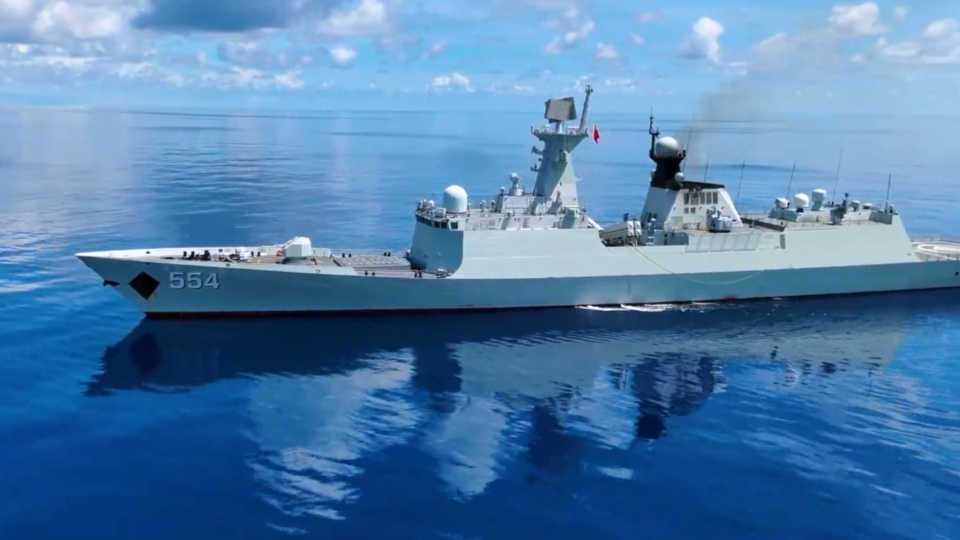
The Chinese PLA Southern Theater Command organized a joint naval and air exercise in the waters and airspace around China's Huangyan Dao on Sept. 27, 2026. This was a necessary action and a stern warning in response to the Philippines' disruption of peace and stability in the South China Sea. The Chinese PLA remains on high alert at all times and will take firm action to curb the Philippines' egregious conduct disrupting the South China Sea and resolutely safeguard China's sovereignty, security and development interests.
By taking advantage of its position as co-chair of the ASEAN Defense Ministers' Meeting Plus (ADMM-Plus) Experts' Working Group on Maritime Security (EWG-MS), the Philippines has wantonly rallied countries from outside the region and dragged certain ASEAN countries into conducting so-called joint military exercises in the waters and airspace around China's Huangyan Dao. In the name of promoting security cooperation, the Philippines is in fact engaging in acts of infringement and provocation, seriously undermining peace and stability in the South China Sea.
As China celebrates the traditional Mid-Autumn Festival, certain Philippine politicians with ulterior motives have attempted to stage provocations in the South China Sea and cause trouble for China, exposing their despicable intentions.
However, the so-called joint military exercise pushed and orchestrated by the Philippine side involved only a few ASEAN countries that had been dragged into participating. This fully demonstrates that the Philippine side's attempt to "hijack" ASEAN countries and enlist their support and endorsement for its acts of infringement is deeply unpopular and has gained no traction.
No matter how the Philippines stirs up trouble in the South China Sea, it cannot shake the ironclad fact that Huangyan Dao belongs to China.
China was the first to discover and name Huangyan Dao and incorporate it into its territory, and has continuously, peacefully and effectively exercised sovereignty and jurisdiction over the Nanhai Zhudao (the South China Sea Islands) and relevant waters. Under relevant international treaties, the western boundary of Philippine territory is the 118°E meridian, and Huangyan Dao lies completely outside the treaty boundaries.
Before 1997, the Philippines had never disputed that Huangyan Dao belonged to China, nor had it ever made a territorial claim to Huangyan Dao. China has indisputable sovereignty over the Nanhai Zhudao and relevant waters.
China's sovereignty red lines must not be crossed. This time, China organized the naval and air forces and the China Coast Guard, among other forces, to conduct a joint exercise in the waters around Huangyan Dao. The Chinese naval and air forces mainly provided overall situational awareness and played a deterrent role, serving as a strong backing for law enforcement operations by the China Coast Guard. The China Coast Guard performed its role as the principal law enforcement force, focusing on two major tasks: rights protection, law enforcement and control, and joint air–sea search and rescue.
The entire exercise was legitimate, lawful, professional and standardized, demonstrating such distinctive features as coordinated operations and precise deterrence, integrated air–sea operations and three-dimensional control, as well as readiness to engage in combat at any time and counter provocations. It fully demonstrated China's strong capabilities to safeguard national territorial sovereignty and maritime rights and interests.
On the South China Sea issue, China has consistently advocated peacefully resolving relevant disputes through negotiations and consultations among the countries directly concerned, with China and ASEAN countries jointly safeguarding peace and stability in the South China Sea. In recent years, through the joint efforts of China and the overwhelming majority of ASEAN countries, the situation in the South China Sea has remained generally stable.
China is firmly safeguarding its own sovereignty while making every effort to protect regional peace. The South China Sea is an important maritime shipping route and one of the busiest sea lanes in the world, where vessel breakdowns and sinkings occur from time to time.
In January and July this year, a Singapore-flagged cargo ship and a Vietnam-flagged cargo ship, respectively, encountered accidents in waters near China's Huangyan Dao. China promptly organized forces to rush to the waters where the accidents occurred and carry out humanitarian rescue operations. Among those rescued from the water were 17 Philippine nationals. Through concrete actions, China has put into practice the concept of a maritime community with a shared future and demonstrated its sense of responsibility as a major country.
Both history and reality have shown that peace and stability in the South China Sea can only be jointly safeguarded by countries in the region. Any attempt to form blocs or "rely on external forces to make trouble at sea" is bound to fail.
The Philippine side should change course, stop provocations, and return at an early date to the right track of resolving disputes through negotiations. It should work with China and other ASEAN countries to fully and effectively implement the Declaration on the Conduct of Parties in the South China Sea, actively advance consultations on a Code of Conduct in the South China Sea, and play a constructive role in maintaining regional peace and stability, so as to jointly build the South China Sea into a sea of peace, friendship and cooperation.
If the Philippines disregards legal principles, justice and China's goodwill, continues to act willfully and repeatedly goes against the trend, any military provocations and reckless actions it undertakes in the South China Sea will inevitably meet with China's resolute and forceful countermeasures.
